Writing to Think

I’m trying to think of a word. Is it existential? Maybe it’s epistemic. I feel like it starts with an “e.” To sort things out, I can ctrl+click on this word in Word and see what synonyms Microsoft suggests. I could go to Google. I could even do it old school and pull out a thesaurus. What I’m trying to illustrate here is that writers have used a variety of tools for nearly two hundred years* to assist them in getting thoughts from their heads onto the page. Is generative AI any different? That’s what I’m going to spend the next six hundred words trying to figure out. 
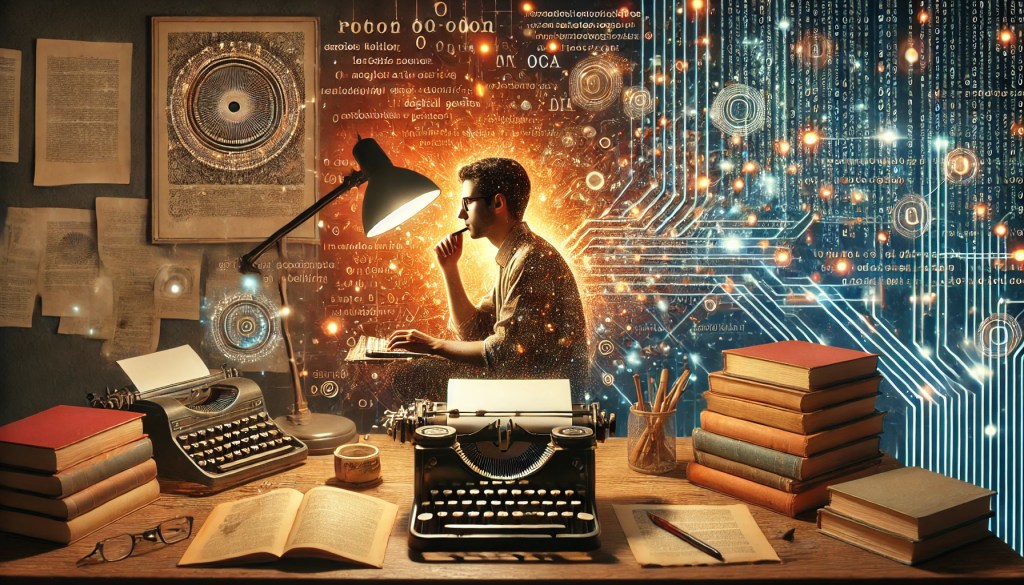
DALL-E's effort to illustrate this blog...

The underlying** problem is that we don’t know how AI impacts thought, especially in developing brains. One theory is that AI can get rid of the drudgery of menial tasks. If I don’t have to worry about dangling modifiers, subject/verb agreement, and double negatives, I can spend my time on more meaningful pursuits. AI could accelerate learning by allowing us to delve into deeper questions.

Another possibility is that AI will lead us to a certain, bland “average.” AI has taken the sum of our digital culture and condensed it into the likeliest outputs. For example, “How do we stop gun violence in the United States?” ChatGPT says, “Stopping gun violence in the United States requires a multifaceted approach that includes implementing comprehensive gun safety laws, addressing root causes like poverty and mental health, improving community support systems, and fostering a culture of responsible gun ownership.” Let’s be honest, I didn’t need to ask ChatGPT to come up with that answer. It’s pretty obvious. But it’s also so non-specific that it’s basically useless. We know these things, and they haven’t worked yet.  We need to figure out why, specifically, they haven’t worked and come up with actionable steps to address them. And this intellectual dead end takes us to the most dire possible impact AI could have on thought. 

If students leapfrog over fundamental lessons, they may fail to develop the critical thinking skills necessary to tackle the world’s biggest problems. Let’s go back to that double negative. When someone’s speaking to us, we can usually tell what they’re trying to say, even if it’s not literally true. I won’t try to confuse you with none of that grammar unclarity. (You know what I mean, right?) But as problems and conversations get more complex, double negatives and dangling modifiers can create serious issues. Worse, if students have been relying on AI to solve their issues up to the point where they get to those more complex problems, they may not have the skills to solve them on their own. 

The truth is, at this point, we just don’t know how AI affects developing brains. Some of the emerging research should certainly make us pause. This study looking at human creativity found that AI’s impact is—to steal a favorite LLM word—“multifaceted.” To sort out exactly what aspects of learning AI accelerates and what parts it damages will require extensive research, attention, and time. To implement these findings will require even more research, attention, and time. But I feel like this is a good place to pivot back to something I wrote in my first paragraph.  “That’s what I’m going to spend the next six hundred words trying to figure out.” 

[Out of curiosity, I copied the preceding paragraphs into ChatGPT and asked it to write a conclusion. Here’s what it came up with.] “In the end, the question of whether generative AI is fundamentally different from the tools writers have always used boils down to its impact on thought and learning. Like a thesaurus or spell-check, it can help us articulate ideas more efficiently, but unlike those tools, it operates on a scale and complexity that could reshape how we think altogether. Whether it accelerates creativity or dulls it into predictable averages, AI challenges us to reevaluate how we approach learning, problem-solving, and even the pursuit of originality. The stakes couldn’t be higher: in an era of unprecedented technological advancement, ensuring that AI enhances rather than erodes critical thinking will determine whether it becomes a powerful ally or a crutch that undermines us in the long run.”

While ChatGPT’s conclusion is true(ish), it’s not where I planned to take this essay because it’s missing a key consideration. Many people think of writing as a way to record and transmit information. That’s true. And AI is actually decent at doing that. But writing is much more than that. Writing is a form of expression. Writing allows us to connect with each other intimately (love notes) or impersonally (jury summons). Writing is performative. (Seriously Hallmark, who is the “Best Dad Ever”?) But that performance serves a social function. (Aren’t those cards more meaningful with a handwritten note?) Writing signals who’s part of our group and who isn’t. And writing can help us find common ground with people who aren’t part of our group. Most relevant to this essay, writing is a way to sort out our thoughts. That’s what I’m doing here. That’s one of the reasons I started blogging. As various writers, including Joan Didion said, “I write entirely to find out what I’m thinking.” The more that students outsource their writing to a machine, the less time they will spend thinking about their words. We don’t yet know the consequences of this outsourcing, but we do know that writing can address many of the deeply human issues facing us today: a lack of critical thought, empathy, meaning, and human connection. Maybe we should spend some more time grappling with our words before we outsource too much of this process to the machines. 

*According to Wikipedia, another writer’s tool, when Peter Mark Roget created Roget’s thesaurus, he “wished to help ‘those who are painfully groping their way and struggling with the difficulties of composition … this work processes to hold out a helping hand.'”

**Maybe the word I was looking for started with “u.”

Ceci Continue de ne pas Etre une Pipe

Photo manipulation is nothing new, and for anyone growing up in the digital age, Photoshop has morphed from a proprietary digital editing program into a verb. Taking it a step further, Google Pixel’s Magic Editor puts Photoshopping right into the palm of your hand. The smartphone app allows you to move, resize, or even delete items from an image. Not happy with what your camera captures in the first place? Canva, Dall-E, Firefly, and other software lets you conjure up any image you can verbalize. Don’t feel encumbered by your lack or experience or, for that matter, reality. We used to say, “It’s only true if there’s pictures.” That’s certainly not the case any more. But was it ever?

In the commercial and theatrical world, professional filmmakers intentionally alter reality. They use all kinds of tricks to make things intimidating, pretty, ugly, or endearing. Makeup, costumes, and lighting turn a perfectly charming Emilia Clarke into the Mother of Dragons.

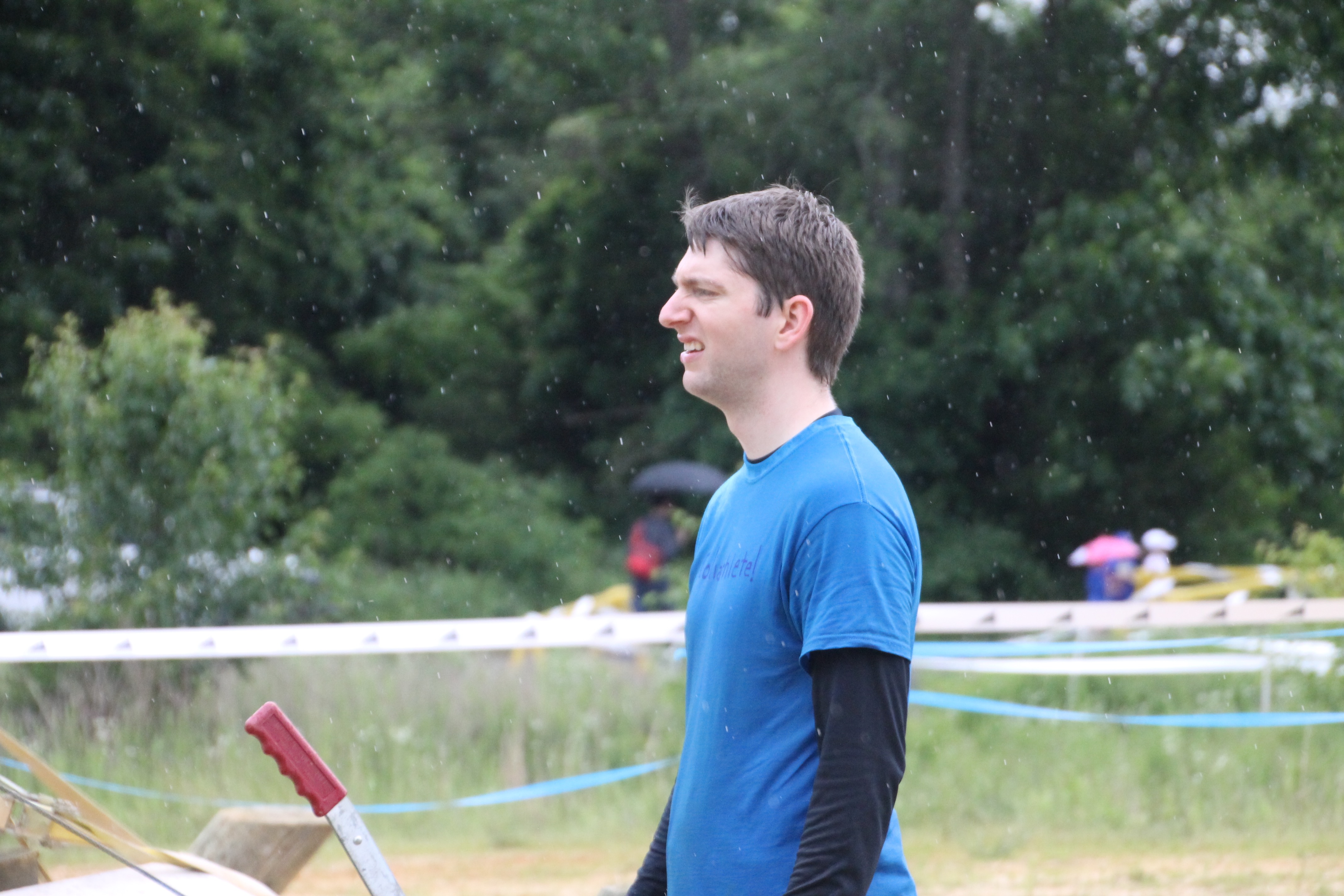
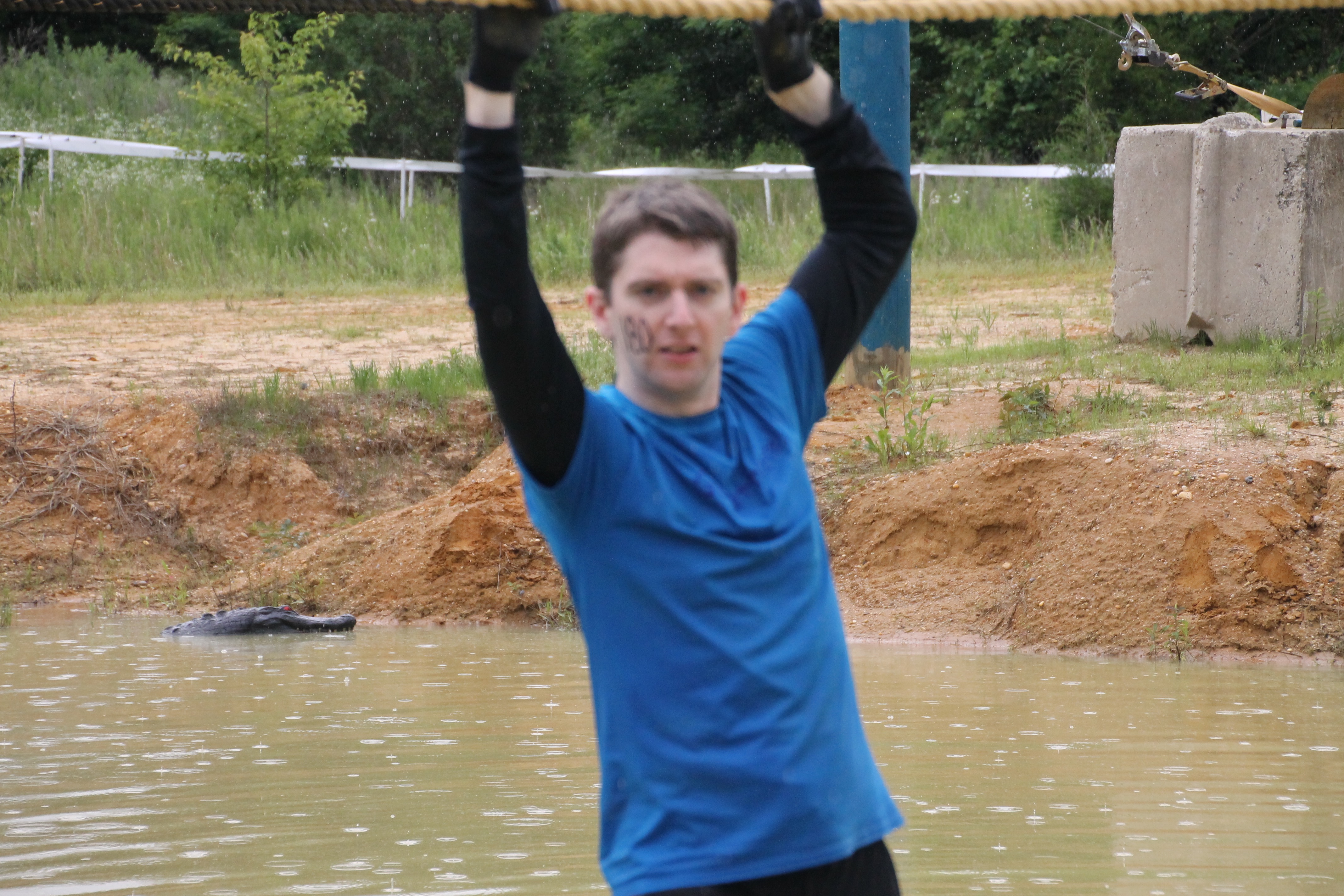
But these tricks are still in play even if you don’t use them intentionally. Here are two pictures of a friend of mine at a mud run.

IMG_8313
IMG_8322

In the first, you can clearly see the falling rain. (No, those aren’t orbs…) In the second, you can see that it is still raining if you look at the water. But the change of angle and focal length means you can no longer see the falling rain. (This is the same reason why it sometimes looks like it’s barely sprinkling at rained out sporting events.) I didn’t hide the rain intentionally, but that’s the reality of the situation.

The important thing to remember is, consciously or not, all media is an interpretation of reality. When you’re on vacation and take a picture, it captures some part of the moment, but it isn’t a recreation of the moment. You’re limited by the abilities of your camera. You choose to photograph the Grand Canyon not the parking lot next to the Grand Canyon. You crop out the guy wearing that ridiculous Hawaiian shirt. And what about the people in your photo? Are they like my nephew, who for two years refused to smile any time someone pointed a camera at him? Or do they ham it up for the camera in the hopes of becoming an internet star?

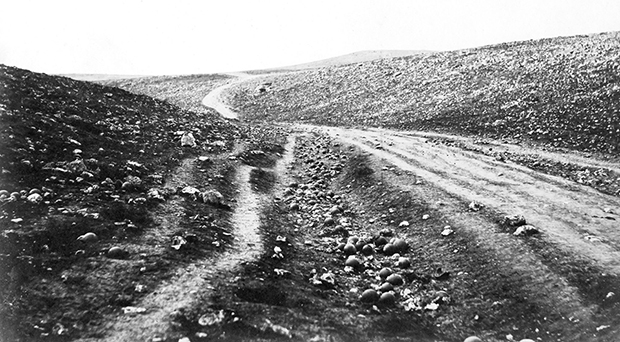
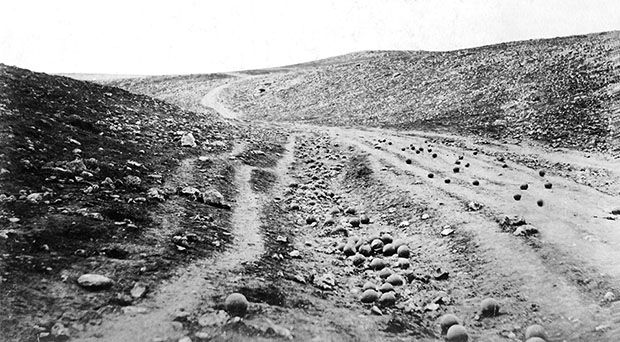
This is nothing new. Film has been an interpretive art since its inception. Below are two of the earliest war photographs ever taken. These are from the Crimean War in 1855, twenty-three years before the first movie was made.

canonball2
canonball 1

Both show a scene of desolation strewn with cannonballs. But it’s the second one that would make photographer Roger Fenton famous. Simply put, it’s a more striking photograph. Fenton wanted to show the horror and destruction of war, but he was restricted by his cumbersome film equipment. His solution? Move the cannonballs onto the road to take advantage of the high contrast. Although it was much more labor intensive than Photoshop, it’s the same basic principle. He altered his photo for effect. He sought a deeper “Truth” that wasn’t reflected in “reality.”

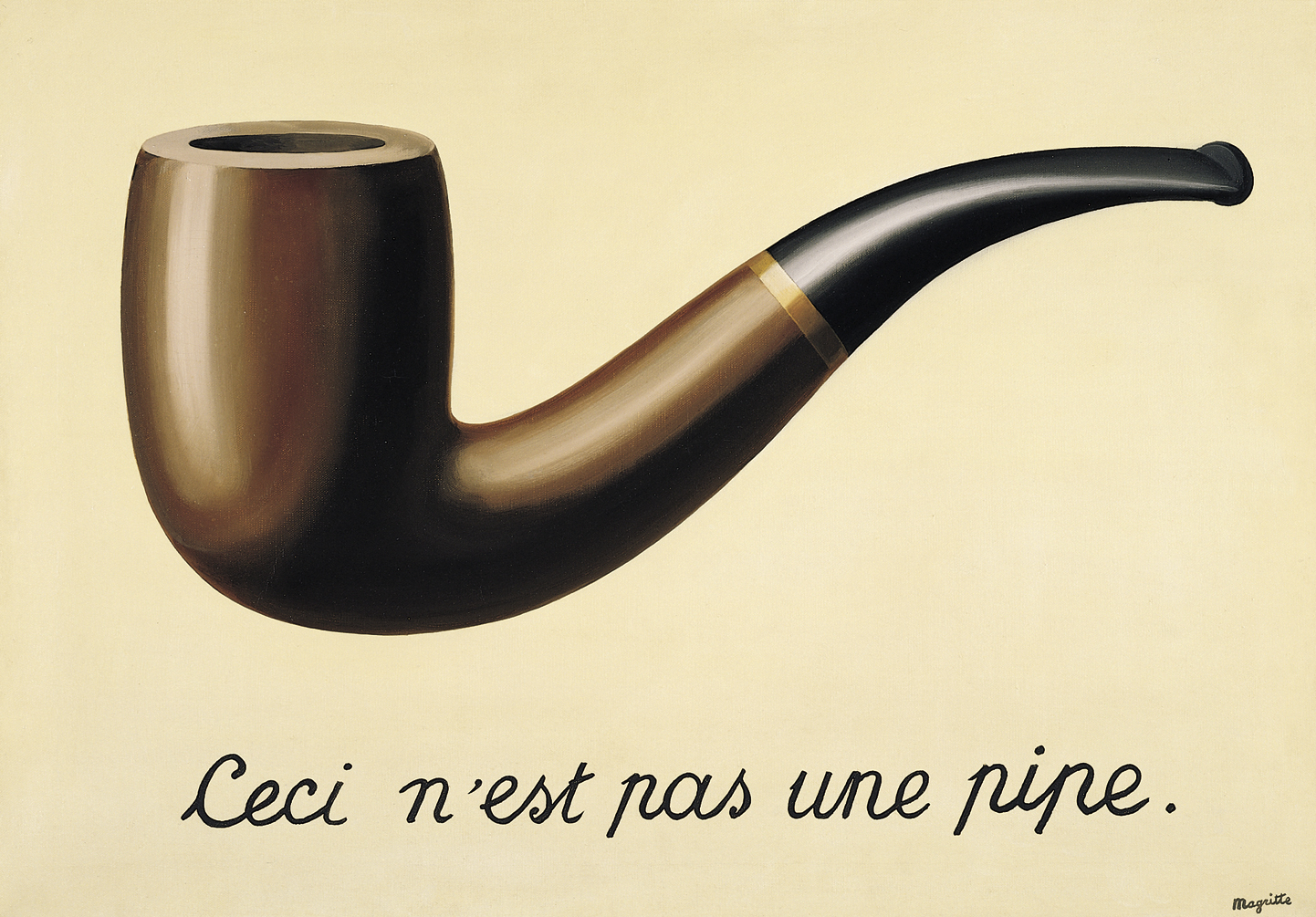
In the late 1920s, surrealist painter Rene Magritte created this thoughtful painting called “The Treachery of Images.”

the-treachery-of-images-this-is-not-a-pipe-1948(2)

If you don’t know French, the text reads, “This is not a pipe.” Of course it’s not a pipe. It’s a painting. It represents a pipe. Our brains conceive of it as a pipe, but it is not a pipe. The same holds true for all media.

A definition might be helpful here. Media is the plural of medium. The two definitions that come to mind are medium (size), as in the size between small and large and medium (fortune teller), as in someone who communicates between the living and the dead. Both contemporary definitions share the same Latin route, medias, which simply means middle. It shouldn’t surprise you that our news sources are generally referred to as “the media.” They are the middlemen. They transport ideas from the source to us. But along the way, they must interpret it.

Media is also used in the art world to describe the material that an artist uses. You may see the phrase “mixed media on canvas.” This medium might be oil paint, latex paint, clay, canvas, silk, steel, analog audio recording, digital video recording, computer programs, or even food. The point is, the artist interprets the world through this medium. Film, as an artistic endeavor, is its own medium. But never forget that the six o’clock news, the news radio traffic report, and the Wall Street Journal all operate in artistic mediums. To explain in more detail, I’d recommend listening to Malcolm Galdwell’s Revisionist History podcast from a 2017.

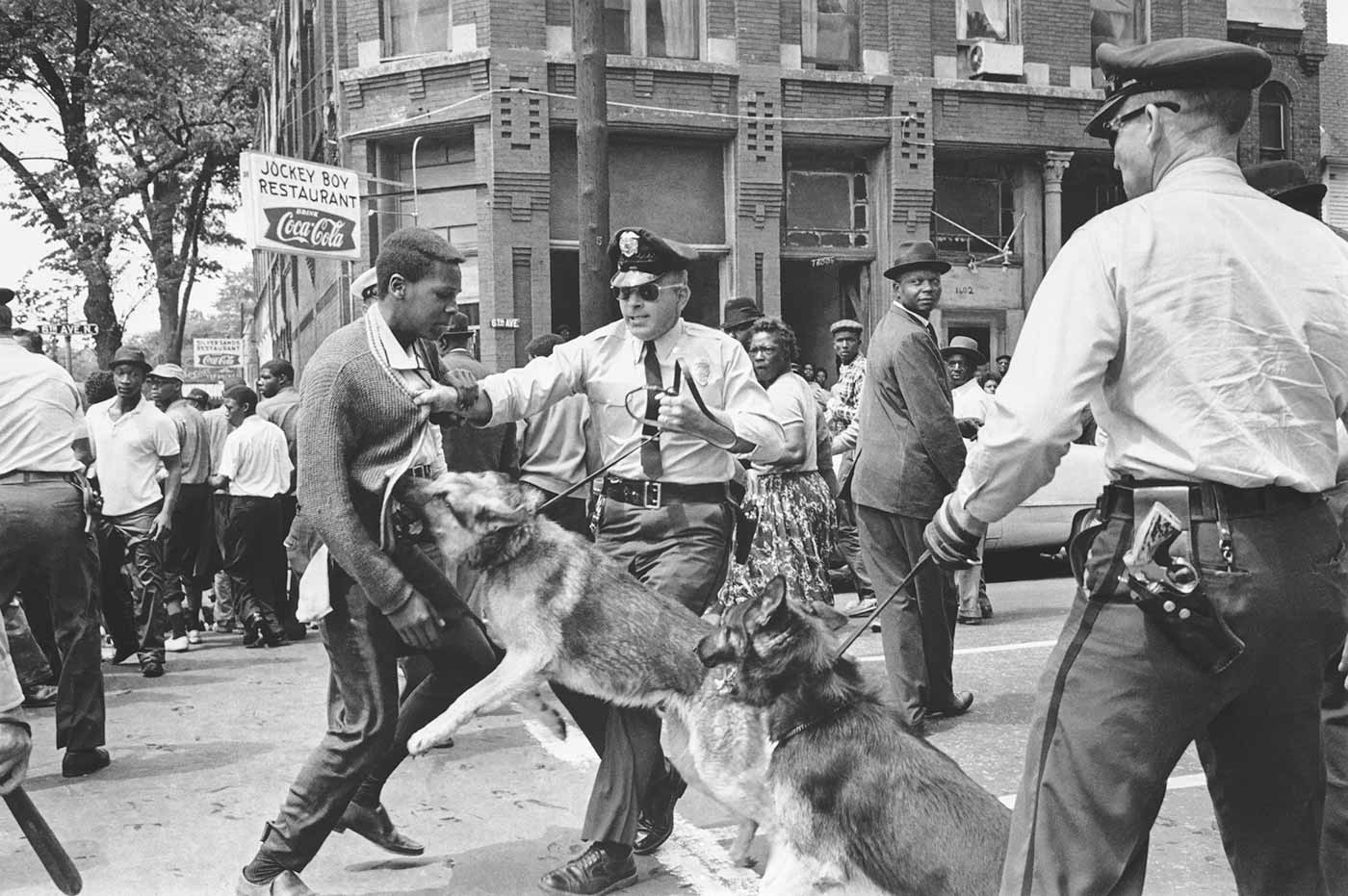
In it, he discusses this famous photograph from Birmingham in 1963.

footsoldier

It seems to show a police officer unleashing his dog on a black protester. But it doesn’t. The man in the photograph wasn’t part of the protest. He wasn’t a “Foot soldier,” as the Civil Rights activists called themselves. And the police officer hadn’t unleashed his dog on him. If you look closely, both men seem surprised and the police officer is leaning back, trying to pull the dog away. But that’s not what the nation saw.

This photo highlighted the brutality of the Jim Crowe south. It represented the discrimination, the institutionalized hate, and the lynchings. It shifted public opinion to the side of the Civil Rights movement, and it was all done on purpose. Bill Hudson, the photographer, chose this picture over the hundreds of other photos he had taken that day. The editor of The New York Times chose to put this story above the fold rather than any other news of the day. This is what a medium does. It takes the raw data, curates it, interprets it, and disseminates a cohesive message. In doing so, a medium must disregard data that fails to support its message or obfuscate its position. In its quest for “Truth,” it must necessarily deviate from “reality.”

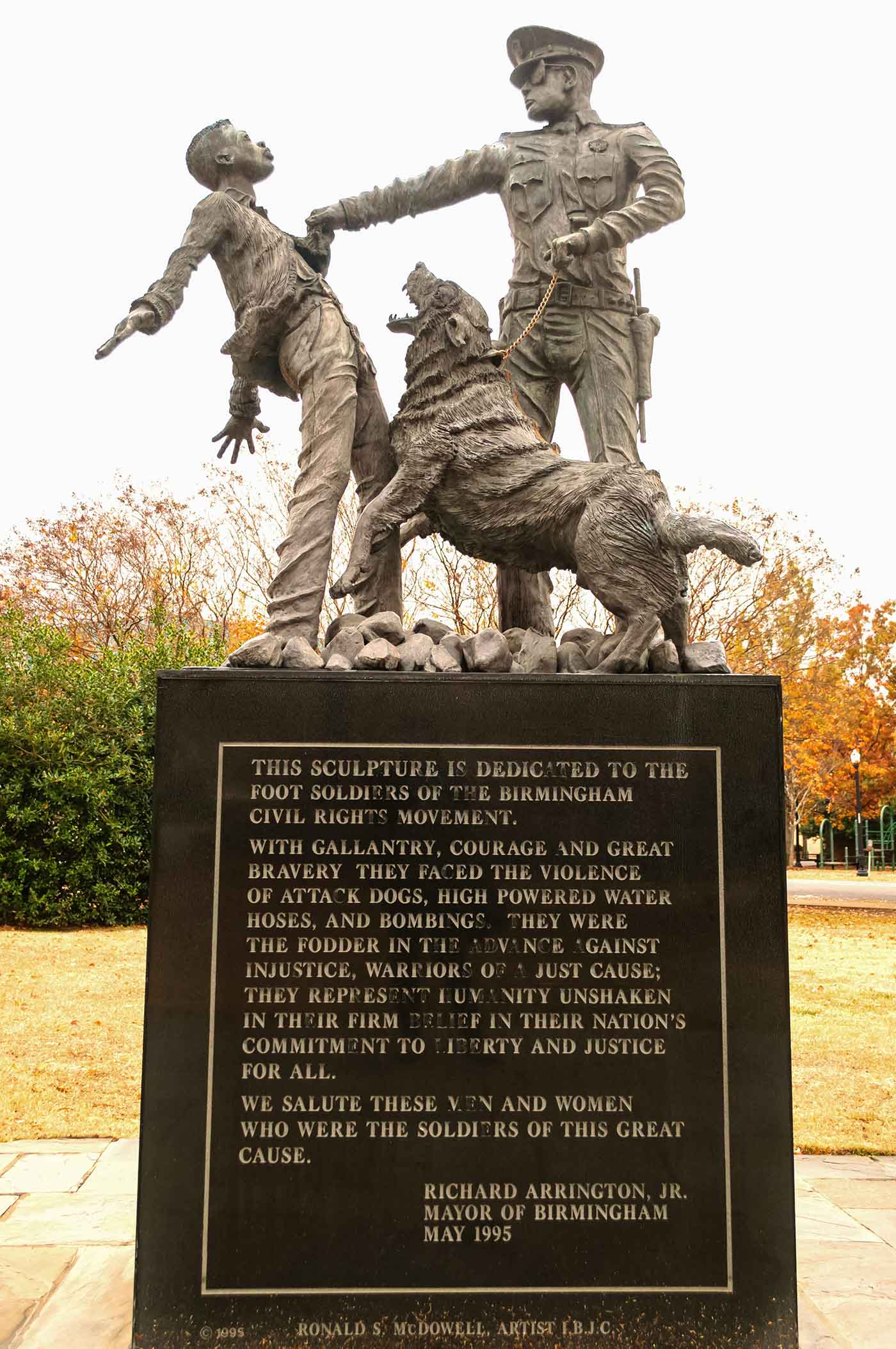
To further clarify, look at Ronald S. McDowell’s statue inspired by Bill Hudson’s photograph.

footsoldier2.jpg

The figure representing Walter Gadsen, the student, is considerably younger and shorter than he was in reality. The police officer is emotionless and inhuman, reminiscent of T-1000 from Terminator 2: Judgment Day, which came out four years before the sculpture was dedicated. The police dog’s mouth is wide open, bearing vicious, anatomically improbable fangs. But remember this is a piece of art. This is not a pipe.

The push and pull between film as art and film as documentation will never end. But as a filmmaker and consumer of media, it’s important to acknowledge that film is a medium. It is not reality. There is no magic bullet, no enforceable code of conduct, no ten commandments of filmmaking that will ever make film purely objective. Reality is reality. Film is film. The best thing you can do as both a filmmaker and a consumer is educate yourself.

It’s important to learn about technology, to learn what is possible and how to spot a fake. But it’s also important to learn about art. You know—art, that thing that gets cut when we want to tighten school budgets. Learn about artistic conventions. Learn to read the meaning behind how a frame is composed, how set decoration reinforces the theme, and how story arcs are constructed. Understand that models and movie stars are just people, too. Play with AI. Appreciate the complex and tragic story of Aaron Copland and Fanfare for the Common Man (examined here in another great podcast). See the allegory between Game of Throne’s White Walkers and climate change. Learn how Proust’s understanding of memory preceded neuroscience. Discover the 1920 play that introduced the word robot and the idea that robots are out to kill us. And, above all, recognize that just because you see a video of something doesn’t mean it’s reality. In fact it’s not reality. It’s just a video. And while there will be a degree of objective truth in it, there will always be a degree of the artist’s truth. After all, it is a video. It is not a pipe.

*NOTE: An earlier version of this blog appeared on this site in 2017. This version has been updated to reflect technological advances, specifically AI.