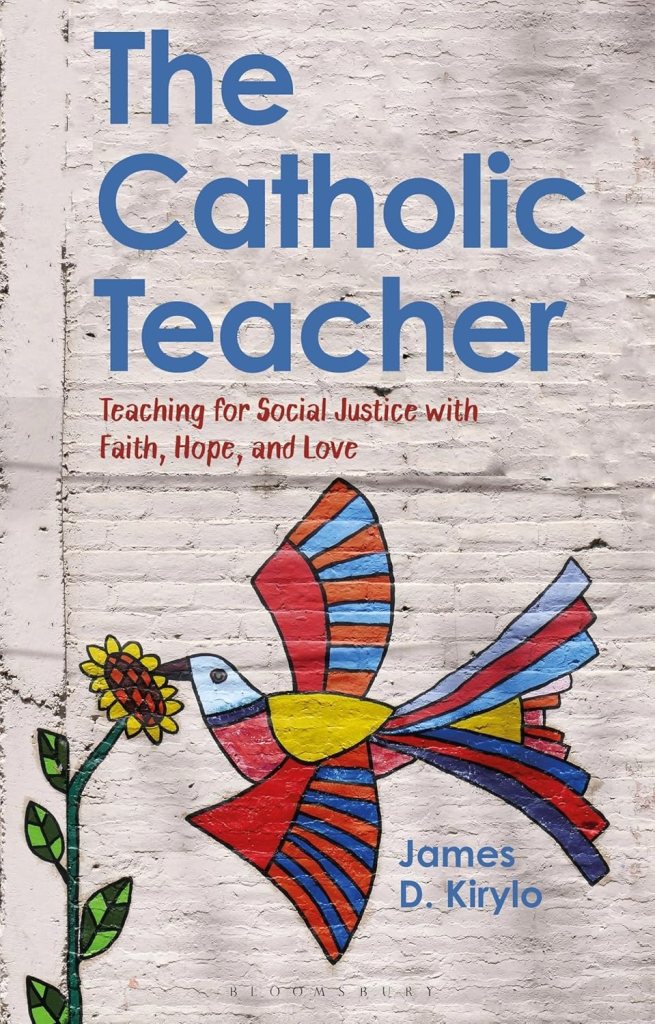
The school year has started, and a major election is less than two months away. Personally, I’ve been wrestling with how to address politics in my class. There are numerous, highly polarized issues that directly affect my students: gun violence, student loans, immigration, even a proposal to eliminate the Department of Education. These contentious issues can seep into classroom discussions and erode the trust necessary to create fruitful discussions and a safe learning environment. Looking for actionable suggestions, I turned to James D. Kirylo’s recently published The Catholic Teacher: Teaching for Social Justice with Faith, Hope, and Love. Sporting an encouraging title and cover art, including chapters on COVID discourse, guns, “the sacredness of life” (i.e. abortion), and climate change, the book appears like it will be a good starting point for difficult conversations. Unfortunately, it aspires to more than it achieves.
Kirylo’s main argument is that educators not only can—but have a moral obligation—to use their faith to guide their teaching. Doing so, however, ought to be dialogic, not didactive. Kirylo writes that his book is meant to be “ecumenical, interfaith, and interreligious in tone. In that way, perhaps the text will be appealing to Catholics and non-Catholics alike” (1). He uses the next few chapters to establish a Catholic tradition of ecumenicalism, but here things quickly unravel. Kirylo’s optimistic tone lacks awareness of the complexity of the issues he discusses and even, in some cases, the Catholic Church’s complicity in these issues. This lack of self-awareness is illustrated well when Kirylo quotes Nostra Aetate. “Since in the course of centuries not a few quarrels and hostiles have arisen between Christians and Moslems, this sacred synod urges all to forget the past” (21). While it’s a nice sentiment, it ignores reality of teaching in a classroom today that likely includes Jewish, Muslim, and Christian students whose lives are being affected by antisemitism, Islamophobia, a war in Gaza, and white Christian nationalism. Taken in this light, Kirylo’s calls for ecumenicalism ring as hollow as Nostra Aetate’s urge to “forget the past.” Instead of a serious proposal to open a dialogue about contentious topics in a pluralistic classroom, Kirylo seems to have a much narrower focus. He’s targeting practicing Catholics who are either unsure if they should take a stance on contentious topics in the classroom or want to take a stance but do not feel as though they have a mandate to do so. While this is a laudable endeavor, it’s a significantly narrower audience and purpose than Kirylo’s hopes stated in the introduction.
Once you realize this narrower purpose, Kirylo’s calls for ecumenicalism feel strangely hypocritical. The first two sections (nearly half of the book) lay a foundation for his purpose in Catholic theology and tradition. While this history lesson may motivate practicing Catholics to imitate their forebearers, it fails to invite other people into the conversation. In other words, if the reader is not swayed by the arguments of Catholic synods and encyclicals, Sections I and II lack any real merit. Section III of the book finally looks at the contentious issues in question. But as the shortest part of the book, Section III lacks the research and thoroughness of the first two sections, simply stating cliched positions on tired issues. Little effort is made to share alternate views, and Kirylo offers no suggestions on how to discuss these issues with people who hold differing positions. And again, Kirylo either misses or ignores what actually makes these topics contentious.
In the case of abortion, for example, Kirylo directly mentions Catholicism’s outgrowth from Jewish theology without acknowledging that the majority of Jewish branches do not consider life to begin at conception (NCJW, Genet). Even his tepid dismissal of contemporary Jewish theology, “There is not a monolithic Jewish point of view” (93), acknowledges that there are a multiplicity of views. How then, should the Catholic educator engage with students whose views disagree and who want to retain their civil rights of bodily autonomy during a political era that seeks to take them away (Guttmacher)?
Then there’s the very germane question of school funding, something that would directly affect Kirylo’s audience no matter how narrow it is. Here Kirylo critiques “neoliberalism” for its efforts to defund “public K-12 education” (69) while ignoring the fact that many Catholics and even the United States Conference of Catholic Bishops push for voucher programs that would remove money and students from the supremely inclusive and democratic public education system.
It’s this blindness or outright disingenuousness that frustrates me the most about Kirylo’s work. While I do believe that his narrow purpose of empowering Catholic teachers is genuine, the lack of critical thought and introspection results in more of a propaganda piece than an insightful work for teaching in a pluralistic, multicultural classroom. Maybe that’s not Kirylo’s fault. Maybe my expectations for the book were too high. Whatever the case, if you’re looking for something to help you with these difficult conversations over the next two months, you’re going to have to look elsewhere.
P.S. For someone who handles difficult conversations well, I recommend Emmanuel Acho’s work.
Uncomfortable Conversations with a Black Man (book)
Uncomfortable Conversations with a Jew (book)
Uncomfortable Conversations with Emmanuel Acho (YouTube)
And for much more thoughtful exploration of gun violence, I recommend Season 8 of Malcolm Gladwell’s Revisionist History.
 Vargoing