
I want to paint a scene for you. A middle eastern city in antiquity. The cacophony of a thousand people speak in Greek, Aramaic, Latin, and Persian—trading, shouting, debating, seducing, joking, gossiping—all the things humans do in any crowded place. A goat’s bleating or cow’s bellow cuts through the racket from time to time. Incense and floral perfumes try to mask the bouquet of body odors, wool, and dung while the scent of wood smoke permeates everything. Bright silks from the far east peek through the dust-coated patina of tans and duns worn by desert traders. Away from market stalls, curious onlookers gawk at a short military procession. Soldiers in pointed iron helmets and long chain mail robes drag a rabble rouser toward the palace. Foot soldiers push people back with their spears while their captain uses a mace to part the crowds. The scene would not be dissimilar from depictions of Jesus of Nazareth being paraded to his crucifixion on Good Friday. In fact, this is probably a reasonable comparison.
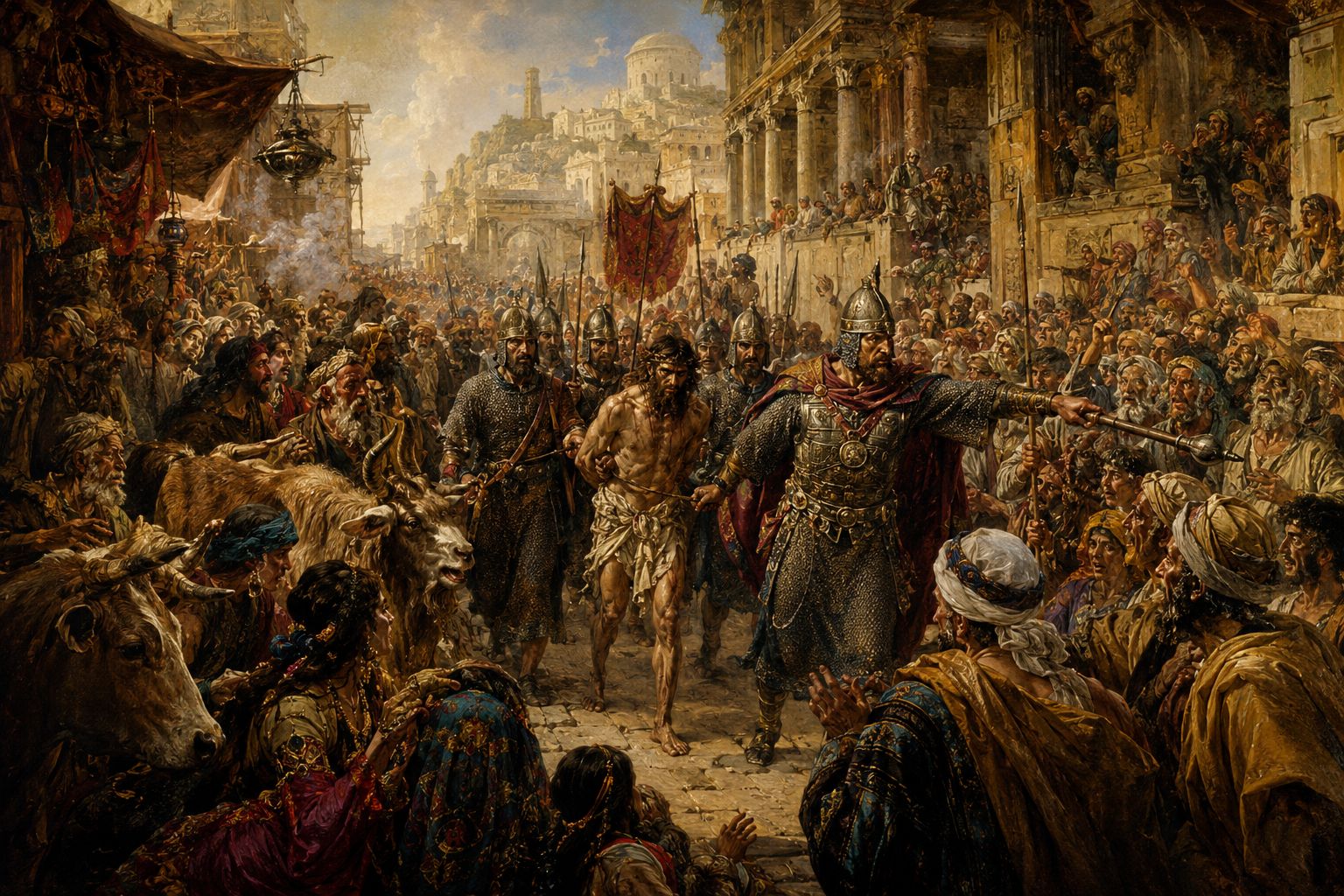
The main character in this tale was also a religious leader. He triumphantly entered the town, Gundeshapur in this case, only a few weeks before. And like Jesus, things had not gone well with the authorities. There are, however, some notable differences between Jesus and the main character of our story, Mani. Mani’s execution took place a few centuries after Jesus’, in 273 AD, in what we would today consider Iran. It was part of the Sasanian empire, which included the modern states of Syria and Iraq as well. It was multicultural (like Jesus’ Jerusalem), but its ruler, Bahram I, promoted Zoroastrianism, a Persian religion that was nearly a thousand years old at that time. Mani had hoped to unite people with his teachings, supplanting Zoroastrianism as well as Judaism, Christianity, gnosticism, paganism, and Buddhism to boot. He was somewhat successful, in that he united people. Unfortunately, he mostly united people against him.
Shortly after his arrival, Bahram I imprisoned him. To make a statement, Bahram turned him into a scarecrow, stripping off his skin and stuffing it with grass. (It’s not clear if Mani was still alive when this happened.) The gruesome effigy, hung above the city gate made its point. Writing 800 years later, Al-Biruni noted that the city entrance was still known as the Mani Gate. And so Mani disappears except as footnotes in history and theology texts. It may sound surprising then to hear that his belief system is alive and well in Silicon Valley.
Today, many techno-optimists believe that technology will spur humanity to evolve into an elevated species. They believe that the metaverse will let us seamless jump through time and space to access all human knowledge. Artificial intelligence and quantum computing will allow us to conceive thoughts and solve problems that were never possible before. Technology, they believe, will make us better, stronger, faster. It will extend our lives so far that we are, practically speaking, immortal, and even if we die, our minds will be cloned in virtual neural networks. Mani, were he alive today, would likely gobble all of this up because it would fix the biggest issue he had—his fallible, corruptible, grass-stuffed body.
Manichaeism, as his theology is known, sees the world as a battle between good and evil. But notably, good is the invisible world of spirit and ideas. Evil is the material world, including human bodies. To Mani, our bodies are holding us back from becoming our pure, perfect selves. It’s our weak bodies that keep us from hitting that marathon personal record—or even wanting to train for the marathon in the first place. It’s our bodies that need feeding and watering and keep us from working sixty hours straight. It’s our bodies that get wrinkles and bald spots and are too short to become NBA stars. Our bodies subject us to poor eyesight, tooth decay, IBS, fatigue, stress fracturs, arthritis, eczema, even allergies. Wouldn’t it be nice if we could overcome these faults and achieve our wildest dreams? This is the fundamental heresy that Bahram I, Christians, and many other groups found fault in. They believe that humans are a spirit and material bodies. In fact, they believe that this tension between our ideals and our physical limitations is a defining characteristic of being human. How do we strive for goodness knowing it’s not possible to achieve? And in the 21st century, science is proving that they are correct.
Consider, for example, anxiety and depression, two disorders that exist primarily “in the mind.”* Would you believe that regular exercise is more effective at reducing symptoms than therapy and medication? Or consider the repercussions of Botox injections, an elective procedure attempting to rectify the universal, human condition of ageing. A growing body of evidence suggests that Botox, which inhibits a person’s facial muscles, hinders their ability to recognize other people’s emotional states. Or consider the fact that constraining your hands reduces language activity in your brain. Then there’s our ability to learn and retain information. Would you believe that writing by hand helps you learn, engage, and retain information better than typing? The key is in that tactile, physicality, the muscle movement, the real world. If we were pure spirits, inhibited by our bodies, the laborious process of handwriting would slow us down. Instead, we find that human beings are a complex combination of mind and body with both contributing to our experience and understanding of the world.
This is the central heresy of AI. AI might prove to be a useful tool for some applications (I used it to help research for this blog and create the first image. It was…okay…at both, though hardly necessary for either), but it is not a substitute for living. That’s what both Mani and the techno-optimists get wrong. Being human isn’t about overcoming an evil body, it’s about coping with the body’s weaknesses and embracing its strengths. Don’t subscribe to a heresy that sees you as little more than a meat machine. Genuine connection does not happen through a screen. Deep learning does not happen online or even in a book. Being human requires the messiness, mistakes, and risks of the real world. Being human requires a body.
The duality of being human—spirit and body—is something that the ancients recognized. That’s why Manichaeism never really caught on. But it’s also why I started this blog post 1800 years in the past. The techno-optimist heresy is nothing new. It’s the same old tune being played on fancier instruments. Interestingly, the antidote for this ancient heresy is the same as it’s always been, too. Go out and experience the world. Do something physical. Touch grass, as the kids say. After all, that is what Mani ended up doing, too. Hopefully, however, you’ll be able to do it under better circumstances.

*I don’t say “in the mind” to be dismissive, only to emphasize the point that a “mental” illness has a surprisingly effective physical treatment. Furthermore, some cases do require medication and ideally medication, therapy, and exercise.


