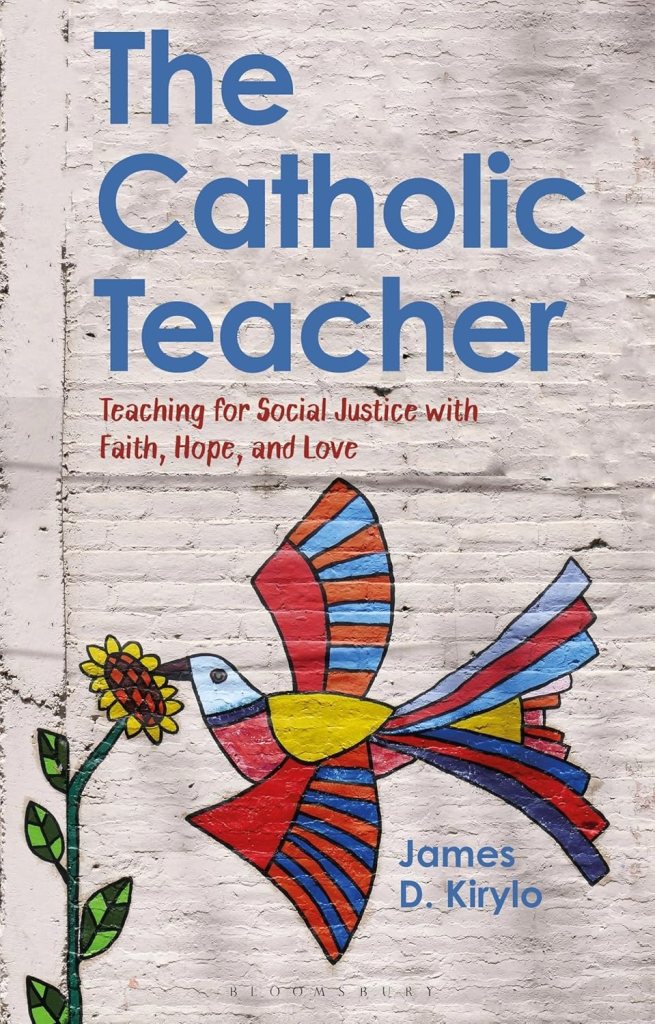
Review of James D. Kirylo’s The Catholic Teacher

The school year has started, and a major election is less than two months away. Personally, I’ve been wrestling with how to address politics in my class. There are numerous, highly polarized issues that directly affect my students: gun violencestudent loansimmigration, even a proposal to eliminate the Department of Education. These contentious issues can seep into classroom discussions and erode the trust necessary to create fruitful discussions and a safe learning environment. Looking for actionable suggestions, I turned to James D. Kirylo’s recently published The Catholic Teacher: Teaching for Social Justice with Faith, Hope, and Love. Sporting an encouraging title and cover art, including chapters on COVID discourse, guns, “the sacredness of life” (i.e. abortion), and climate change, the book appears like it will be a good starting point for difficult conversations. Unfortunately, it aspires to more than it achieves. 
Kirylo’s main argument is that educators not only can—but have a moral obligation—to use their faith to guide their teaching. Doing so, however, ought to be dialogic, not didactive. Kirylo writes that his book is meant to be “ecumenical, interfaith, and interreligious in tone. In that way, perhaps the text will be appealing to Catholics and non-Catholics alike” (1). He uses the next few chapters to establish a Catholic tradition of ecumenicalism, but here things quickly unravel. Kirylo’s optimistic tone lacks awareness of the complexity of the issues he discusses and even, in some cases, the Catholic Church’s complicity in these issues. This lack of self-awareness is illustrated well when Kirylo quotes Nostra Aetate. “Since in the course of centuries not a few quarrels and hostiles have arisen between Christians and Moslems, this sacred synod urges all to forget the past” (21). While it’s a nice sentiment, it ignores reality of teaching in a classroom today that likely includes Jewish, Muslim, and Christian students whose lives are being affected by antisemitism, Islamophobia, a war in Gaza, and white Christian nationalism. Taken in this light, Kirylo’s calls for ecumenicalism ring as hollow as Nostra Aetate’s urge to “forget the past.” Instead of a serious proposal to open a dialogue about contentious topics in a pluralistic classroom, Kirylo seems to have a much narrower focus. He’s targeting practicing Catholics who are either unsure if they should take a stance on contentious topics in the classroom or want to take a stance but do not feel as though they have a mandate to do so. While this is a laudable endeavor, it’s a significantly narrower audience and purpose than Kirylo’s hopes stated in the introduction. 

Once you realize this narrower purpose, Kirylo’s calls for ecumenicalism feel strangely hypocritical. The first two sections (nearly half of the book) lay a foundation for his purpose in Catholic theology and tradition. While this history lesson may motivate practicing Catholics to imitate their forebearersit fails to invite other people into the conversation. In other words, if the reader is not swayed by the arguments of Catholic synods and encyclicals, Sections I and II lack any real merit. Section III of the book finally looks at the contentious issues in question. But as the shortest part of the book, Section III lacks the research and thoroughness of the first two sections, simply stating cliched positions on tired issues. Little effort is made to share alternate views, and Kirylo offers no suggestions on how to discuss these issues with people who hold differing positions. And again, Kirylo either misses or ignores what actually makes these topics contentious. 

In the case of abortion, for example, Kirylo directly mentions Catholicism’s outgrowth from Jewish theology without acknowledging that the majority of Jewish branches do not consider life to begin at conception (NCJW, Genet). Even his tepid dismissal of contemporary Jewish theology, “There is not a monolithic Jewish point of view” (93), acknowledges that there are a multiplicity of views. How then, should the Catholic educator engage with students whose views disagree and who want to retain their civil rights of bodily autonomy during a political era that seeks to take them away (Guttmacher)?

Then there’s the very germane question of school funding, something that would directly affect Kirylo’s audience no matter how narrow it is. Here Kirylo critiques “neoliberalism” for its efforts to defund “public K-12 education” (69) while ignoring the fact that many Catholics and even the United States Conference of Catholic Bishops push for voucher programs that would remove money and students from the supremely inclusive and democratic public education system. 

It’s this blindness or outright disingenuousness that frustrates me the most about Kirylo’s work. While I do believe that his narrow purpose of empowering Catholic teachers is genuine, the lack of critical thought and introspection results in more of a propaganda piece than an insightful work for teaching in a pluralistic, multicultural classroom. Maybe that’s not Kirylo’s fault. Maybe my expectations for the book were too high. Whatever the case, if you’re looking for something to help you with these difficult conversations over the next two months, you’re going to have to look elsewhere. 

P.S. For someone who handles difficult conversations well, I recommend Emmanuel Acho’s work. 

Uncomfortable Conversations with a Black Man (book)

Uncomfortable Conversations with a Jew (book)

Uncomfortable Conversations with Emmanuel Acho (YouTube)

And for much more thoughtful exploration of gun violence, I recommend Season 8 of Malcolm Gladwell’s Revisionist History.

The Danger of a Single Story

Stories are critical to our understanding of ourselves and of the world. But stories are not TRUE. The world is chaotic and indifferent. Humans are contradictory and ever changing. Singular events like the migration of a humpback whale or a dance at senior prom or a parking ticket have no real meaning. In order to make sense of ourselves—where we’ve come from and where we’re going—we tell stories. 

Seeing that humpback whale off the coast of Cape Cod may reignite your love of marine biology. Wonderful Tonight may perpetually remind you of your first true love. That parking ticket may be just one of the myriad ways the universe lets you know “the man” is out to get you. This is storytelling, putting the events of our lives into context and using them to shape our identities. 

Some psychologists and anthropologists argue that storytelling is uniquely human, that it is, in fact, what makes us human. That theory may just be another story, but storytelling is certainly a strength. What is “Hamlet” or “the stock market” or “human rights.” You can’t feed a monkey the S&P 500, and yet it’s a critical part of our world. 

Stories, however, can also be dangerous. Stories are not reality. They are not TRUE. Stories simplify things, omit details, take a certain point of view. As psychologist Jerome Bruner said, “To tell a story is inescapably to take a moral stance.” In her Ted Talk, “The Danger of a Single Story,” novelist Chimamanda Adichie explains the hazards of the stories we tell and the stories we omit. It is worth a listen. I’ll wait.

The danger of a single story is not merely that it limits our understanding of the world or that it limits what we think we are capable of. The biggest danger, I would argue, is that if we only hear one story, we start to think it is TRUE. 

In 2020, we are being asked to re-evaluate many of the stories we have been told for decades, in some cases centuries. These stories address race, gender, patriotism, service, loyalty, victimhood, history, bravery, citizenship, equality, essentiality, responsibility, heroism, and many more things. They address our very identities. Remember, stories, by their very nature, are critical to our understanding of ourselves and the world. This process won’t be comfortable. That’s okay. New stories bring us to a fuller, more colorful understanding of the world. New stories bring us closer to the TRUTH. 

I’d like to leave with this anecdote. In the late nineteenth and early twentieth century, the United States was publicly, virulently white supremacist.

In part to thumb their noses at the White, Anglo-Saxon, Protestant (WASP) establishment, a Catholic fraternal organization took Christopher Columbus for their patron. By the late 19th century, Americans had been celebrating Columbus as a mythic hero for 100 years. The WASPs liked to tell a story of Christopher Columbus discovering America but conveniently ignored the fact that he was an Italian (Catholic) funded by Spaniards (Catholic). Italian, Irish and other Catholic immigrants wanted to remind WASPs that Catholics played a major role in creating the United States.

A century after the Knights of Columbus were formed, we may question their choice of patron. Here is Kurt Vonnegut’s reflection on Columbus from Breakfast of Champions in 1973:  

“As children we were taught to memorize [1492] with pride and joy as the year people began living full and imaginative lives on the continent of North America. Actually, people had been living full and imaginative lives on the continent of North America for hundreds of years before that. 1492 was simply the year sea pirates began to rob, cheat, and kill them.”

What’s the TRUTH? Well, all of it. The world is chaotic. It is not simple and neat. It’s natural for us to associate these stories with our identities. To think that an attack on Columbus is an attack on our selves. But it’s not. It’s just a new perspective. It moves us to a fuller and more interesting understanding of the world. It moves us away from the dangerous, myopic belief in a single story. 

Screenwriters, do yourselves a favor.

HBO recently released Craig Mazin’s miniseries ChernobylWhile nothing in this life is perfect, Chernobyl comes pretty darn close. From acting to directing to art direction to sound design, Chernobyl is a masterclass in filmmaking.

But the biggest story is probably the story itself. In the television world, screenwriters hold the creative power and, as writer and executive producer, Mazin made a variety of bold and effective decisions. For example, the explosion takes place in the first few minutes of the mini-series. He doesn’t make the audience sit through a lengthy first act or ordinary world, and it’s spectacularly powerful. But his reasoning behind the decision is what will really make things click for filmmakers.

In addition to the show, Mazin recorded a companion podcast with NPR host Peter Sagal to accompany each episode. In it, he explains his creative decisions. He shares insight about story structure, adapting true stories, portraying gore on screen, sound design, and even accents. It’s entertaining, engaging, and informative. It’s unfiltered information coming from a filmmaker at the top of his game.

Taken together, Chernobyl and the companion podcast are worth far more to aspiring filmmakers than anything you can find in a university catalogue. The podcast is free and HBO Now has a 7 day free trial. You have no excuses. If you want to learn about the craft of filmmaking, Chernobyl is a must.

Time and Reality

Last year, I wrote a post about Unity or Time (or why biopics have good acting, but are really boring). The basic problem is that real life is mostly boring. And even when you condense a very interesting person’s life into a two hour window, you’re violating one of the foundational laws of screenplay physics: your main character (real or fictional) is under pressure. If they do not achieve their goal soon, they will face serious, negative consequences. (Kind of hard to make that argument when your screenplay covers seventy years…)

John Lee Hancock’s The Founder sidesteps problem in two very clever ways. Overall, it is a very well put together film, and unquestionably worth your time. But if you’re struggling to make your “based on true events” story engaging, you should take particular note of how The Founder handles time.

The_Founder_poster.png

The Founder tells the story of McDonald’s founder Ray Kroc (deftly and engagingly portrayed by Michael Keaton). One may argue that it is not a proper “biopic” in that it doesn’t tell Kroc’s life story. But that’s point number one. Ray Kroc is only interesting to us because he founded McDonalds (well, franchised it, but whatever… you have to watch the movie). We don’t care what his childhood was like, what he did during the war, or how he whiled away his golden years.* And Hancock wisely choses to focus on that one interesting “moment” of Kroc’s life: the founding of McDonalds.

The second, more interesting point, is in how Hancock handles time: he doesn’t. Intellectually, we know it takes time to get building permits, train staff, track revenue growth, etc. And all of this time, while Kroc is waiting to turn a profit, he’s sweating bullets. But Hancock never tells us how much time has passed. He never shows the changing of the seasons or ages Michael Keaton. So while the real events took anywhere form weeks to years, the pacing of the film feels like each scenes follows day after day and may only have taken a week or two. It’s entirely engrossing.

This all falls back on Robert D. Siegel’s expertly crafted script that continues to escalate and grow with each new scene. We’re not sure how long it takes for Kroc to realize he’s not making any money, and it doesn’t matter. The point is, he’s not making any money. This leads to a second infuriated phone call to the McDonalds brothers, Kroc’s wife finding out about the mortgage, and Kroc’s quest to reduce refrigeration costs (a plot point that instigates all kinds of other interesting complications). The story just keeps pressing onward.

Is this an accurate representation of Ray Kroc’s life? I can’t say. But I can tell you it’s a movie. And it’s a damn good one. So keep these two tricks up your sleeve as you work on your future projects, especially if they’re based on true events. When you get down to it, your audience’s time is the biggest factor you need to consider. And if they are emotionally engaged in your movie, they won’t be looking at the clock. It may not be a burger in thirty seconds, but it’s a service you should definitely aim to provide.


*Some mention of Kroc’s backstory (previous failed business ventures) is appropriately and entertaining revealed as backstory through dialogue in the second act of the film. It’s a great case study in effective use of dialogue and exposition.

The Pope in the Pool

I just watched The Big Short last night. It’s a good film with some incredible acting and editing. It’s unique in how it blends drama and documentary—a feat that required breaking many of “the rules.” Despite that, it had a consistent style, which made it work.

But let’s be honest, a film about credit default swaps has a lot of explaining to do. For that they used Blake Snyder’s trick—mentioned in my last post—called the Pope in the Pool.

If you haven’t read it yet, I’m going to recommend again that you read Save the Cat. But to briefly sum up, when a script has to cover exposition (those boring plot points that you need to explain to the audience even though the characters already know what’s going on) you can distract your audience with something visually interesting.

In Snyder’s case, the Pope is swimming in his pool while receiving a security briefing. You’re so mesmerized seeing the Pope in a bathing suit swimming in the Vatican pool, you barely even notice the bone dry dialogue. (Hence, Pope in the Pool.)

The Big Short has three clear—dare I say gratuitous—examples. The first is the scene with Margot Robbie (a nice nod to The Wolf of Wall Street), then there’s Anthony Bourdain, and finally Selena Gomez with Dr. Richard Thaler.

The latter two examples work very well. Anthony Bourdain making soup out of his unsold fish was a visual example of how banks were repackaging securities to make CDOs. The line of betting at the blackjack table with Selena Gomez created a visual example of how investors would bet on CDOs to create synthetic CDOs.

Margot Robbie’s scene doesn’t work quite as well because there’s no visual correlation between what she’s doing (drinking champagne in a tub) and what she’s explaining (sub-prime loans). Had she been paying for the champagne, it may have worked better.

In many ways, the whole movie is an example of “Pope in the Pool.” It was dramatizing some dull, heady banking practices. It’s a shame this movie couldn’t have existed before the financial crash because people may have better understood the crisis they were creating. (This is one of the reasons people love science fiction. It prophesies what could happen if we don’t change our ways.) In any event, it’s a great example of how something boring and difficult to understand can connect to audiences in a meaningful way through effective filmmaking and visual storytelling.

A Roundabout Review of “Medici: Masters of Florence”

New screenwriters will often ask if they have to follow “the rules.” The short answer is, “Yes.” Why? Keep reading.

There are some great scripts that break “the rules.” But there are many, many, many terrible scripts that break “the rules,” and it’s easier to understand why the rules exist by watching some of these terrible movies (and TV shows). Medici: Masters of Florence, currently available on Netflix, is one of them. Here are some of my thoughts organized with the same headings used for industry standard coverage.

medici-master-of-florence

STRUCTURE

You’ve probably heard of the three-act structure. I alluded to it in my previous post about Extraordinary Worlds. The purpose of the first act (AKA “The Beginning”) is to establish the characters and their needs. It builds empathy between the characters and the audience and gives the audience an idea of where this script is headed.

Medici starts by killing off Dustin Hoffman. We don’t know who he is. We don’t know why we should like him. Maybe it’s a good thing he’s being killed off. We immediately jump to Richard Madden (apparently Hoffman’s son) who is trying to decide how to respond to his political rivals. Again, it’s a little unclear who Madden is or why we should like him.

Hoffman’s death is cut together with scenes of Hoffman’s own funeral making the opening sequence even more confusing. Once we establish that A) Hoffman was the Medici patriarch, B) he is dead, C) Madden is his son, and D) Madden must now fill his ample shoes, Medici immediately jumps to a flashback.

In general, flashbacks are poor storytelling. Scripts are written in present tense because they happen now, and now is important. Flashbacks tell the audience that whatever happened then is more important than what is happening now. Well if then is more important than now, why not have your script take place then?

Although Madden’s hair is different and Hoffman is inexplicably alive, there’s no real way to distinguish now from then, continuing Medici’s theme of baffling confusion. This confusion is the bigger sin than merely using a flashback. The flashback not only fails to contribute to Madden’s contemporary story (his appointment to the signoria), but makes the show difficult to follow. And just when you thought the show was about to buckle down and do some proper storytelling, it dives into a montage.

Montages, like flashbacks, are generally poor storytelling. They can be used for a variety of reasons, but are most frequently used to compress time. In sports movies, you can’t show your heroes playing all 162 regular season games, but you can show a montage. When your warrior is training for the final battle, you don’t bore your audience with thirty minutes of calisthenics and meditation, you use a montage. In the pilot episode of Medici when Madden falls hopelessly in love with a laundress and drives a rift between him and his father, you should probably play that out for a few episodes. Well, they used a montage, and it was laughable. How can we possibly care about the love of his life when she’s only on screen for three minutes?!

Similarly (back to now), a surgeon who performed an illegal autopsy on Hoffman blackmails Madden. Madden informs his consigliere to pay the surgeon 100 Florins. When the consigliere pays the money, the surgeon demands 1000 Florins. Seems like a pretty important scene, right? We never get to see it! Madden’s consigliere just tells him about it in painful exposition a few scenes later. Why wouldn’t you use that scene?!

To sum up structure, there’s no real first act, the story is difficult to follow, the pacing is wildly off, and important scenes are not included in the script. Moving on…

CHARACTER

Hoffman and Madden may develop into interesting, likeable characters, but they certainly don’t start out that way. Madden is dour and brooding. Hoffman is, well, dead. In the flashback he kind of seems like a jerk. Maybe they’ll redeem themselves, but I’m not sure if I’ll watch long enough to see that. (Not all protagonists need to be likable, but they do need a redeeming quality. This is where Blake Snyder got the name for his fantastic screenwriting book Save the Cat.)

Madden’s lover (and most of the tertiary characters) are paper-thin. She’s posing for a group of artists only partially clothed. Despite all of the other eligible young men in the room, she and Madden are instantly smitten with each other. This leads to the aforementioned three-minute sex montage. (Now that I think about it, maybe it was just three minutes of sex. Again, the story was hard to follow.) In any case, it’s not the kind of deep reflection on the human condition that leads to memorable characters. Oh, by the way, she’s scared out of Madden’s life a few minutes later by his dad’s henchmen. (Another scene that is only talked about, not shown.)

There’s a brother, a not particularly intimidating antagonist, the consigliere, a cameo by the artist Donatello, and a handful of other forgettable characters who take themselves too seriously. The only entertaining person is Steven Waddington who plays a cheeky cardinal who bribes his way to the papacy.

DIALOGUE

But wait, it gets worse! If you’ve ever studied Uta Hagen (It’s bonus credit, but I do recommend reading Respect for Acting), you know that actors need motivation. When they lack motivation, your scene runs a very high risk of exposition. After all, if your characters have no motivation, they have nothing to do, and will just end up talking.

In Medici, there’s the awful scene where Hoffman’s rival sort of threatens Madden, but mostly explains that the signoria is rigged. Then there’s the scene where Madden’s wife explains that she’s been a loyal wife who wants to be part of his business decisions. But the one that really takes the cake is the scene between Hoffman and Madden about Hoffman’s legacy.

In it, Hoffman waxes philosophic about his legacy, complains about Madden’s desire to be an artist (another terrible example where “showing” would have been more powerful than “telling”), and explains his scheme for gaining power. Why have this elaborate, dull conversation full of exposition? Because it’s the middle ages and they have nothing better to do when travelling from place to place?

Now they could have been trying to convince someone to join their cause. Hoffman could have been scolding his son wasting resources on art. Or they could have been doing something visually interesting while having a boring conversation (another great tip from Blake Snyder that he calls “Pope in the pool”). Instead, it’s five mind-numbing minutes of exposition. C’mon, people.

The other thing that really kills the scene (while this isn’t in the writer’s purview), is Hoffman’s accent. Everyone else in the series sounds like they’re doing Shakespeare. Hoffman sounds like they pulled him out of a dock in the Bronx. The tough guy persona could work well, but the juxtaposition is distracting.

UGH…

On top of all of this, there was a painful and distracting soundtrack. It was almost as though they realized the show was horrible and were trying to draw your attention away from it.

With the difficultly of following the story, lack of empathy for the characters, and laughable dialogue, it was really hard to care. I ended up reading about the Medici on Wikipedia—which I found much more interesting—and frankly don’t know how the episode ended. More importantly, I don’t care.

This may not be a glowing review, but I do recommend you watch the pilot episode of Medici: Masters of Florence. It’s much easier to understand “the rules” when you see what happens if you break them.

What’s This Script About, Anyway?

People like to joke that in movies there’s always a parking spot right in front of the courthouse/airport/lawyers office/spaceship the protagonist is trying to get to. There’s a reason for that. Finding a parking spot is boring. Nobody cares. I watch movies to escape the mundaneness everyday life. Unless your script is Parking Wars*, I don’t want to see people looking for parking spots.

Occasionally, I’ll see writers include this kind of stuff in their script. If it’s a neurotic Woody Allen-esque comedy, it works. Fast and Furious 17: The Later Years? Maybe. Schindler’s List? No. The bigger landmine you have to watch out for is accidentally getting on a tangent that you didn’t mean to.

I’m currently reading a novel that has multiple characters pray or mention praying at multiples times. So what? Well, this is purportedly a legal thriller. But when you have enough characters come to Jesus, you’re actually looking at a religious novel set over the backdrop of lawyerly intrigue. I don’t think this was the author’s intent. She’s gone on a tangent.

“But people pray!” you’re saying to yourself. “I’ve seen it. At least in movies.” Yes. They also park cars. But they always have a parking spot. If you have created a character who prays before meals and blesses themselves every time they hear an ambulance, prayer is just a manifestation of their character. If all of your characters pray, talk about prayer, struggle with prayer, use prayer to solve problems, you’ve just written a script about prayer.

I don’t want to knock prayer—or parking for that matter. Tangents can be anything: folding laundry, having sex, checking your email, playing Frisbee Golf, or going to the bathroom. If a character uses the bathroom, no big deal. But if they go multiple times, it becomes a character trait (Irritable Bowel Syndrome?). If multiple characters need the bathroom throughout the script, your audience is going to think someone poisoned the craft service table. They may have. But is that what your movie is about?

Here are 2 great exceptions that prove the rule. Hanna and Stranger than Fiction both include tooth-brushing scenes. Nobody cares about brushing their teeth. But Marissa Wiegler and Harold Crick do. Their meticulousness contrasts them with the rest of humanity and defines their character. This seemingly benign act is critical to the story. The prayer mentioned above? Not so much.

Remember, you’re writing fiction, not documenting daily life. Everything in your script is there for a reason. If it doesn’t contribute to the story, don’t put it in. Don’t confuse or bore your audience with mundane details. Don’t go on a tangent!


*I worked on Parking Wars. It was a “reality show” about fighting tow truck drivers. I thought I would die. Not figuratively.