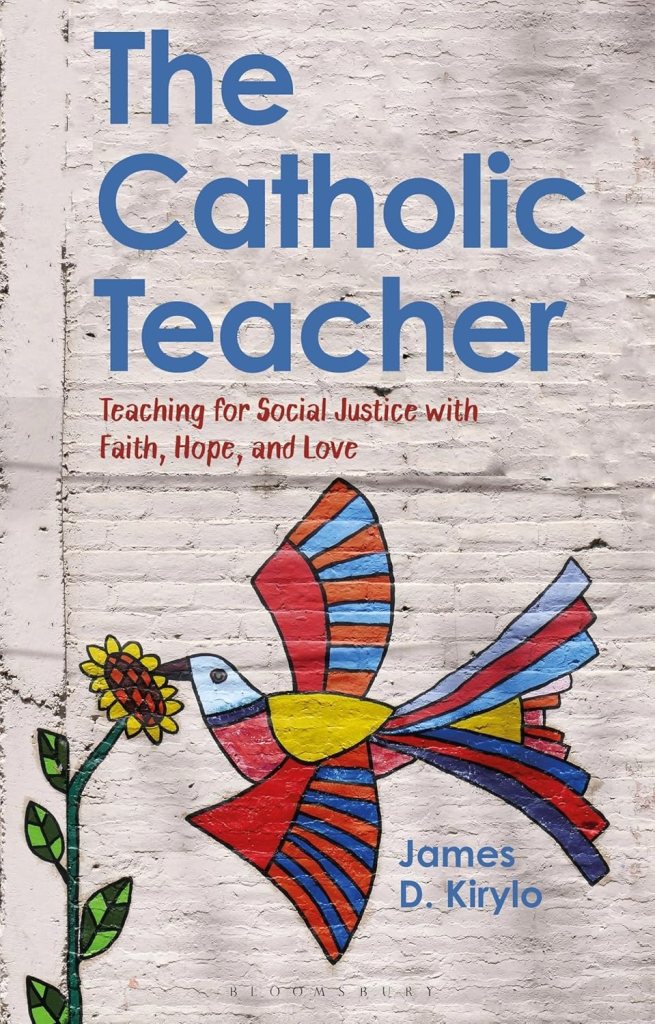
Review of James D. Kirylo’s The Catholic Teacher

The school year has started, and a major election is less than two months away. Personally, I’ve been wrestling with how to address politics in my class. There are numerous, highly polarized issues that directly affect my students: gun violencestudent loansimmigration, even a proposal to eliminate the Department of Education. These contentious issues can seep into classroom discussions and erode the trust necessary to create fruitful discussions and a safe learning environment. Looking for actionable suggestions, I turned to James D. Kirylo’s recently published The Catholic Teacher: Teaching for Social Justice with Faith, Hope, and Love. Sporting an encouraging title and cover art, including chapters on COVID discourse, guns, “the sacredness of life” (i.e. abortion), and climate change, the book appears like it will be a good starting point for difficult conversations. Unfortunately, it aspires to more than it achieves. 
Kirylo’s main argument is that educators not only can—but have a moral obligation—to use their faith to guide their teaching. Doing so, however, ought to be dialogic, not didactive. Kirylo writes that his book is meant to be “ecumenical, interfaith, and interreligious in tone. In that way, perhaps the text will be appealing to Catholics and non-Catholics alike” (1). He uses the next few chapters to establish a Catholic tradition of ecumenicalism, but here things quickly unravel. Kirylo’s optimistic tone lacks awareness of the complexity of the issues he discusses and even, in some cases, the Catholic Church’s complicity in these issues. This lack of self-awareness is illustrated well when Kirylo quotes Nostra Aetate. “Since in the course of centuries not a few quarrels and hostiles have arisen between Christians and Moslems, this sacred synod urges all to forget the past” (21). While it’s a nice sentiment, it ignores reality of teaching in a classroom today that likely includes Jewish, Muslim, and Christian students whose lives are being affected by antisemitism, Islamophobia, a war in Gaza, and white Christian nationalism. Taken in this light, Kirylo’s calls for ecumenicalism ring as hollow as Nostra Aetate’s urge to “forget the past.” Instead of a serious proposal to open a dialogue about contentious topics in a pluralistic classroom, Kirylo seems to have a much narrower focus. He’s targeting practicing Catholics who are either unsure if they should take a stance on contentious topics in the classroom or want to take a stance but do not feel as though they have a mandate to do so. While this is a laudable endeavor, it’s a significantly narrower audience and purpose than Kirylo’s hopes stated in the introduction. 

Once you realize this narrower purpose, Kirylo’s calls for ecumenicalism feel strangely hypocritical. The first two sections (nearly half of the book) lay a foundation for his purpose in Catholic theology and tradition. While this history lesson may motivate practicing Catholics to imitate their forebearersit fails to invite other people into the conversation. In other words, if the reader is not swayed by the arguments of Catholic synods and encyclicals, Sections I and II lack any real merit. Section III of the book finally looks at the contentious issues in question. But as the shortest part of the book, Section III lacks the research and thoroughness of the first two sections, simply stating cliched positions on tired issues. Little effort is made to share alternate views, and Kirylo offers no suggestions on how to discuss these issues with people who hold differing positions. And again, Kirylo either misses or ignores what actually makes these topics contentious. 

In the case of abortion, for example, Kirylo directly mentions Catholicism’s outgrowth from Jewish theology without acknowledging that the majority of Jewish branches do not consider life to begin at conception (NCJW, Genet). Even his tepid dismissal of contemporary Jewish theology, “There is not a monolithic Jewish point of view” (93), acknowledges that there are a multiplicity of views. How then, should the Catholic educator engage with students whose views disagree and who want to retain their civil rights of bodily autonomy during a political era that seeks to take them away (Guttmacher)?

Then there’s the very germane question of school funding, something that would directly affect Kirylo’s audience no matter how narrow it is. Here Kirylo critiques “neoliberalism” for its efforts to defund “public K-12 education” (69) while ignoring the fact that many Catholics and even the United States Conference of Catholic Bishops push for voucher programs that would remove money and students from the supremely inclusive and democratic public education system. 

It’s this blindness or outright disingenuousness that frustrates me the most about Kirylo’s work. While I do believe that his narrow purpose of empowering Catholic teachers is genuine, the lack of critical thought and introspection results in more of a propaganda piece than an insightful work for teaching in a pluralistic, multicultural classroom. Maybe that’s not Kirylo’s fault. Maybe my expectations for the book were too high. Whatever the case, if you’re looking for something to help you with these difficult conversations over the next two months, you’re going to have to look elsewhere. 

P.S. For someone who handles difficult conversations well, I recommend Emmanuel Acho’s work. 

Uncomfortable Conversations with a Black Man (book)

Uncomfortable Conversations with a Jew (book)

Uncomfortable Conversations with Emmanuel Acho (YouTube)

And for much more thoughtful exploration of gun violence, I recommend Season 8 of Malcolm Gladwell’s Revisionist History.

2020 Presidential Election

Today, I am officially announcing an exploratory committee to run for the president of the United States in 2020. Is this a joke? No. What’s up with the exploratory committee? I’ll get to that.

As children, we were all told that we could be anything when we grew up, even the president of the United States. This year, I suppose I am a grown up, at least according to the constitution. I am now 35, which is the minimum age you must be in order to become president of the United States. As a citizen, I think it is important to participate in the political process and part of that participation is understanding how the process actually works.

In order for you to “officially” be a candidate for president, or any other office for that matter, you need to meet various requirements. In the case of president, you must raise or spend $5,000 on your campaign. Then you have ten days to file a “Form 2” with the Federal Elections Commission and appoint a campaign committee including a treasurer.

Although it’s a fairly low bar, it is the first of several safeguards from “prank” candidates. It also makes anyone who does not have $5,000 to throw around seriously consider whether this is worth it. That is the first reason for forming an “exploratory committee” rather than “officially” filing to run.

“Ballot access” or actually having your name appear on the ballot for an election is the next hurdle. It varies by state, in some cases by county, and differs between the primary and the  general election. Generally speaking, you can either be appointed your party’s official candidate (however there are limits to what parties appear on a ticket) or you can collect a certain number of signatures. In the case of Montgomery County, Pennsylvania, if you belong to one of the major political parties, you need 2,000 signatures from voters registered with that party. If you are not running under a major party, you “must obtain signatures from qualified registered electors of the district in an amount equal to at least 2% of the largest entire vote cast for an elected candidate at the last election within the district.”

Due to the fact that I am currently working 2 jobs and am a grad student, my wife has advised me not to run. However, these initial stages of the exploratory process have already been informative, and I am curious to hear more from readers about their experiences with political campaigns.

I would also like to reassert that I meet the base requirements to be president of the United States. I am a natural born United States citizen. I am 35. And I have lived her for at least the last 14 years. I may not be the most qualified person for the job, but I am certainly not the least. If my “official” candidacy does not pan out, you can always consider me for a write in.

bipartisan4

Smoking Pipes to Smoking Guns: The Deepfake

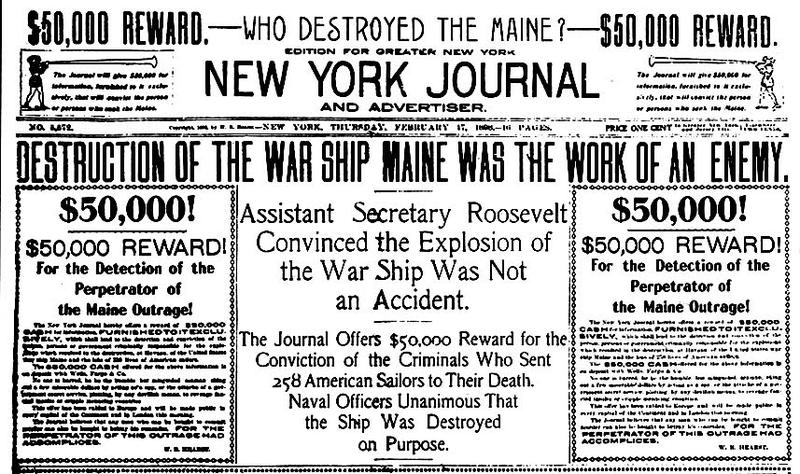
Two years ago, I wrote a post about some new technologies that were allowing video editors to create realistic videos of things that never happened. Today, we call them “Deepfakes.” I think it’s worth a re-read. In it, I argue that education–particularly arts education–is the most effective way to combat the Deepfake. After all, Deepfakes aren’t really new. We’ve been dealing with “fake news” and propaganda for hundreds of years. How would you have responded to this story from February of 1898? The U.S. went to war.

USS_Maine
Image Source

But it did have me wondering. What do we do with a Deepfake? How should we treat some kind of shocking video or audio revelation? I don’t exactly have a checklist, but I think we need to look at scandalous revelations holistically. What else supports this shocking news? Do the facts add up? Where did the evidence come from?

The problem is (and I acknowledge that Hollywood is largely at fault for perpetuating this myth), we are obsessed with the “smoking gun.” There will be some single, irrefutable piece of evidence that proves our point and wins the day. But as I say repeatedly on this blog, movies aren’t real life. “Smoking gun” evidence rarely exists, and when it does, it’s usually not enough to prove much of anything.

Strangely, Trump’s infamous “Access Hollywood” tape offers a perfect case study for Deepfakes. Here we had a presidential candidate caught red handed saying absolutely repugnant things about women, about mothers, daughters, sisters, friends, and loved ones. The Democrats thought this was it for his campaign. They finally had hard evidence of what a narcissistic, sexist pig he was. But it didn’t matter.

Everyone already knew all of that. They knew he didn’t respect women. They knew he was vulgar. They knew he was lewd. It didn’t matter. Trump didn’t even try to deny it. He could have decried it as a Deepfake, but he didn’t need to. The smoking gun was just that, all smoke and no fire.

Is it possible for some video of dubious origin to crop up at an inopportune time in efforts to sway the public’s mind? Yes. Should the NSA stay abreast of Deepfake technology? Of course. But I think the situation is overblown. McKinley didn’t need video evidence of the Maine explosion to invade Cuba in 1898. Bush didn’t need video evidence of WMDs to invade Iraq in 2003. The question is less about what kind of evidence we have and more about what kind of sources we gather that evidence from. Keep that in mind as the conversation continues.

The Contemporary Samaritan

This Sunday’s gospel reading comes from Luke, chapter 10, verses 23-37. It’s a very well known story, commonly referred to as the parable of the “Good Samaritan.” It contains a powerful, difficult message to help your neighbor, whoever that person may be. Even if you don’t know them. Even if you don’t like them.

Jesus was a storyteller. He could have just said, “Try to be nice to everyone,” but that’s not exactly what came out. Instead he offered a powerful example of how to be nice, what extent you ought to go to, and who frequently falls short. It’s actually an uncomfortable, divisive message. Remember, Jesus was a revolutionary. He wasn’t put to death for telling people to be nice. But somehow I feel that we lost the real power of his message over the millennia.

So on this weekend, when our president is trying to deport as many undocumented immigrants as possible, I thought it might be a good idea to revisit Luke’s gospel with a more contemporary interpretation.

The Contemporary Samaritan

“There was once an entrepreneur and veteran who ran a small coffee shop in an up-and-coming neighborhood. Everyone agreed it was a sound business investment and would  really help increase property values while providing jobs for local residents. One night, after working twenty-three hours straight, he momentarily let his guard down while taking out the trash. Robbers jumped him and forced him to empty the safe at gunpoint.  They beat him up so he couldn’t call for help and left him for dead on the sidewalk.

It so happened that a politician was on his way from a fundraising event in a motorcade with several members of the press. They passed the man lying on the street and one of the reporters asked what the country should do about it. The politician said this was exactly why he promoted a tough-on-crime domestic policy, which he would enact right after the next election. He offered his thoughts and prayers to everyone suffering from the lawlessness that had been enabled by the lax policies of his political rivals. Even though there were six dozen people in the motorcade, no one from the press or the politician’s personal staff stopped to see if the man was okay.

A short while later, a red-blooded, God-fearing American came down the street. He had voted for Hillary in the last election. He didn’t really like the Clintons, but he really didn’t like Trump. He didn’t think his vote mattered anyway. That’s why he didn’t vote in the midterms and never bothered to research who was running for county commissioner or D.A. He saw the man on the sidewalk and briefly thought about giving him some money. He looked like he was in bad shape. But the man would probably just use it on drugs, and his cousin (who had a thing for painkillers) already owed him seven hundred bucks. Hadn’t he given enough to people who couldn’t get their shit together? Besides, he wrote a check to the food bank for $100 every year at tax time.

Shortly after passing the badly beaten entrepreneur, the man thought he should probably call the cops, but then it occurred to him that the cops might want him to stay, and he’d had a long day and really needed a beer. So he kept walking.

At last, a Mexican who had overstayed his work visa came upon the man. The Mexican felt bad because he used to be in a gang, and had bloodied a few people up over the years. He was trying to make up for it, so he decided to stop and help. He gave the man first aid and took him to a hospital. At the hospital, he left his contact information in case man or the police needed to get ahold of him, even though the Mexican realized that if they really wanted, the police would be able to track him down and deport him. After that, the Mexican, even though he had a degree in civil engineering and had spent the last ten hours driving for Uber, went to work his second job as a dishwasher.

And Jesus concluded, ‘I really tried to spell this out for you.'”