Review of James D. Kirylo’s The Catholic Teacher

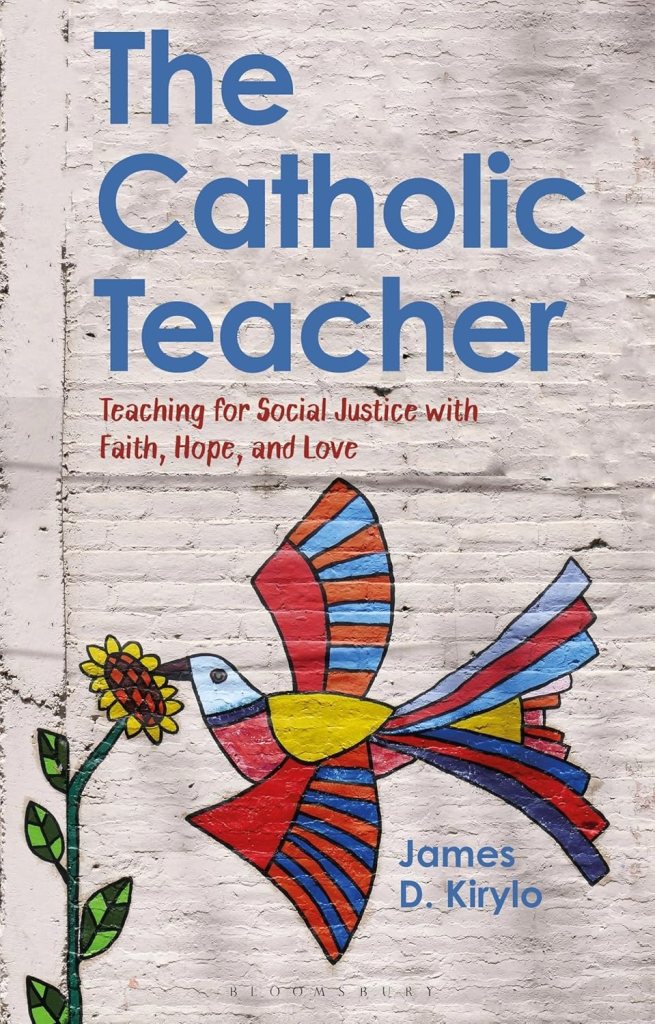
The school year has started, and a major election is less than two months away. Personally, I’ve been wrestling with how to address politics in my class. There are numerous, highly polarized issues that directly affect my students: gun violencestudent loansimmigration, even a proposal to eliminate the Department of Education. These contentious issues can seep into classroom discussions and erode the trust necessary to create fruitful discussions and a safe learning environment. Looking for actionable suggestions, I turned to James D. Kirylo’s recently published The Catholic Teacher: Teaching for Social Justice with Faith, Hope, and Love. Sporting an encouraging title and cover art, including chapters on COVID discourse, guns, “the sacredness of life” (i.e. abortion), and climate change, the book appears like it will be a good starting point for difficult conversations. Unfortunately, it aspires to more than it achieves. 
Kirylo’s main argument is that educators not only can—but have a moral obligation—to use their faith to guide their teaching. Doing so, however, ought to be dialogic, not didactive. Kirylo writes that his book is meant to be “ecumenical, interfaith, and interreligious in tone. In that way, perhaps the text will be appealing to Catholics and non-Catholics alike” (1). He uses the next few chapters to establish a Catholic tradition of ecumenicalism, but here things quickly unravel. Kirylo’s optimistic tone lacks awareness of the complexity of the issues he discusses and even, in some cases, the Catholic Church’s complicity in these issues. This lack of self-awareness is illustrated well when Kirylo quotes Nostra Aetate. “Since in the course of centuries not a few quarrels and hostiles have arisen between Christians and Moslems, this sacred synod urges all to forget the past” (21). While it’s a nice sentiment, it ignores reality of teaching in a classroom today that likely includes Jewish, Muslim, and Christian students whose lives are being affected by antisemitism, Islamophobia, a war in Gaza, and white Christian nationalism. Taken in this light, Kirylo’s calls for ecumenicalism ring as hollow as Nostra Aetate’s urge to “forget the past.” Instead of a serious proposal to open a dialogue about contentious topics in a pluralistic classroom, Kirylo seems to have a much narrower focus. He’s targeting practicing Catholics who are either unsure if they should take a stance on contentious topics in the classroom or want to take a stance but do not feel as though they have a mandate to do so. While this is a laudable endeavor, it’s a significantly narrower audience and purpose than Kirylo’s hopes stated in the introduction. 

Once you realize this narrower purpose, Kirylo’s calls for ecumenicalism feel strangely hypocritical. The first two sections (nearly half of the book) lay a foundation for his purpose in Catholic theology and tradition. While this history lesson may motivate practicing Catholics to imitate their forebearersit fails to invite other people into the conversation. In other words, if the reader is not swayed by the arguments of Catholic synods and encyclicals, Sections I and II lack any real merit. Section III of the book finally looks at the contentious issues in question. But as the shortest part of the book, Section III lacks the research and thoroughness of the first two sections, simply stating cliched positions on tired issues. Little effort is made to share alternate views, and Kirylo offers no suggestions on how to discuss these issues with people who hold differing positions. And again, Kirylo either misses or ignores what actually makes these topics contentious. 

In the case of abortion, for example, Kirylo directly mentions Catholicism’s outgrowth from Jewish theology without acknowledging that the majority of Jewish branches do not consider life to begin at conception (NCJW, Genet). Even his tepid dismissal of contemporary Jewish theology, “There is not a monolithic Jewish point of view” (93), acknowledges that there are a multiplicity of views. How then, should the Catholic educator engage with students whose views disagree and who want to retain their civil rights of bodily autonomy during a political era that seeks to take them away (Guttmacher)?

Then there’s the very germane question of school funding, something that would directly affect Kirylo’s audience no matter how narrow it is. Here Kirylo critiques “neoliberalism” for its efforts to defund “public K-12 education” (69) while ignoring the fact that many Catholics and even the United States Conference of Catholic Bishops push for voucher programs that would remove money and students from the supremely inclusive and democratic public education system. 

It’s this blindness or outright disingenuousness that frustrates me the most about Kirylo’s work. While I do believe that his narrow purpose of empowering Catholic teachers is genuine, the lack of critical thought and introspection results in more of a propaganda piece than an insightful work for teaching in a pluralistic, multicultural classroom. Maybe that’s not Kirylo’s fault. Maybe my expectations for the book were too high. Whatever the case, if you’re looking for something to help you with these difficult conversations over the next two months, you’re going to have to look elsewhere. 

P.S. For someone who handles difficult conversations well, I recommend Emmanuel Acho’s work. 

Uncomfortable Conversations with a Black Man (book)

Uncomfortable Conversations with a Jew (book)

Uncomfortable Conversations with Emmanuel Acho (YouTube)

And for much more thoughtful exploration of gun violence, I recommend Season 8 of Malcolm Gladwell’s Revisionist History.

Stranger Than Fiction

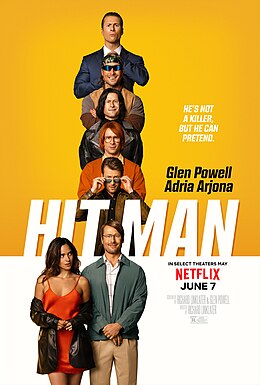
Here’s a screenplay pitch for you. Psychology professor by day, undercover cop by night. Not just an undercover cop, but an undercover cop posing as a hit man. In this least, I hope you say, “Go on.” On top of that basic premise, this psychology professor is the kind of forgettable, mild-mannered dweeb you fist imagined, but his hit man persona is a mix between Dirty Harry and John Wick. And as his college classes delve into questions about id and identity, he starts to wonder who he really is. When we get to the crisis moment, however, he’s no longer wondering if his true calling had always been undercover cop. He’s wondering if his true calling had been a real hit man.

That’s the premise of Richard Linklater’s Hit Man on Netflix. Seems like a surefire blockbuster. It’s even based on the true story of Gary Johnson, a psychology professor who had been moonlighting as an undercover cop for the Houston Police Department in the 80’s and 90’s. He’d been profiled by Skip Hollandsworth in Texas Monthly a few years ago. The problem, however, is that Linklater cleaved too closely the source material, creating a decent biopic rather than a blockbuster movie. I want to briefly delve into what didn’t work. 

The big problem with this movie is that screenplays are complete fictions. While they may be based on real life, they are not real life. Real life is chaotic and absurd. Screenplays (hopefully) are not. Everything in a screenplay should be intentionally placed there to form a tight, cohesive narrative–a sort of logical argument. If A, then B; if B, then C; and so on until you end up with hopefully a logical and fulfilling conclusion.

I’ll defer to Anton Chekov here who rephrases what I’m trying to say much more directly and cleanly. “If in the first act you have hung a pistol on the wall, then in the following one it should be fired. Otherwise don’t put it there.” The screenplay for Hit Man, however, includes numerous unfired pistols. These come directly from Hollingsworth’s source material, and while they are fascinating glimpses into the human psyche, they do not progress the narrative or Gary Johnson’s growth as a character. (Keep in mind here that Gary Johnson the character is different than Gary Johnson the person.)

Here are three bizarre, true anecdotes from Hollingsworth’s article that Linklater chose to keep in the movie (despite their irrelevance to Johnson’s story). The first is an example of how a person starts looking for a hit man: a seedy gentleman asks a stripper(?!) if she could recommend anyone. Second, Hollandsworth writes about a teenager who wanted to off one of his classmates (changed to his mother in the movie). Third, he relates a family inheritance dispute that ends up with a brother forgiving his sister for trying to hire a hit man. The judge in the case grants her probation. All three of these anecdotes are crazy and fascinating, but I argue that you could cut them without losing anything. In fact, you’d have a better movie, and here’s why. 

Go back to that first paragraph I wrote. If this movie is exploring whether or not Gary Johnson wants to become a real hit man, how exactly does the high school student fit in? Why is it important for the audience to go to the strip club and eavesdrop on two characters (the seedy patron and stripper) who we’ve never met and will never see again? In short, it’s not. 

This is Gary Johnson’s story. Those scenes are deviations from that story. While they do show the diversity of clients that Johnson must deal with and his ability to read a variety of clients, we have another dozen characters in the “Undercover Gary Montage” that do the same thing. That makes those scenes unnecessary. Worse, it also makes them confusing. 

At the point where we meet the teenager, this movie has established that Johnson is working with a variety of unsavory people and becoming increasingly comfortable in his role as a “hit man.” If we, the audience, see a deviation from norm that the screenplay has established for unsavory people (in this case because of age), the teenager becomes Chekov’s gun. We expect the story to pivot at this point. There is a complication to the movie’s “ordinary world.” The main protagonist must overcome this new obstacle and learn something about themselves. But…he doesn’t.

The other two scenes operate in a similar fashion. While they’re both interesting anecdotes (How does someone find a hit man? What happens after you learn that someone hired a hit man to kill you?) they aren’t central to the plot. They don’t tell us anything about Johnson’s new identity. Instead they introduce irrelevant characters and locations. They are “pistols” that never get fired. In the logical argument that is Gary Johnson’s story, they are Red Herrings. 

It’s important to point out that Gary does have a meeting with a unique client that causes him to change his entire operation. Madison Masters is an attractive young woman trapped in an abusive relationship. Rather than going through with the sting, he suggests she get out of the relationship. He also begins to wonder if some people are, perhaps, legitimate targets for a hit man. That’s the crux of the movie. This is where things get interesting. This is in fact the inciting incident. Those other three anecdotes should have been left in the Hollingsworth’s profile piece.

Additionally, the movie suffers from an overused, uninteresting voiceover. And Gary Johnson’s character fails to adequately differentiate his “real” self and his hit man persona. What are we left with? An okay biopic that takes a handful of major liberties from the source material. As Hollandsworth’s original article proves, the truth is often stranger than fiction. Good fiction, however, is far more focused than reality. 

The Death of the Artist

In his book, The Death of the Artist, William Deresiewicz laments the decline and fall of the blue collar, professional artist. And while he unpacks a variety of legitimate and terrifying issues such as the unravelling of historic institutions and the job gobbling monster that is big tech (problems that affect everyone, not just artists), I feel like he misses a certain perspective about the motion picture industry. While the industry manages to sidestep many of the issues plaguing other artistic endeavors, it’s not avoiding them altogether. Because it’s a complex, multi-layered situation, I think it might be instructive to look at the motion picture industry through the three specific lenses: technology, art, and business. 

Technology (What is film?)

Deresiewicz differentiates between television and film, but it’s an arbitrary distinction. With the exception of the live or live-to-tape multi-camera shoot, production crews make feature films, television shows, and used car commercials the exact same way. Only a decade ago, we filmed thirty-second lottery commercials on 35mm Kodak. The question of “what is a film” has less to do with being “filmed” than how the content is delivered to an audience. 

In that regard, feature films suffer from a major constraint: they need to be long enough to justify the price of admission but short enough to satisfy an audience before their legs fall asleep. To do that, many films rely on tropes and cliches to keep a story moving forward. The boom in quality television over the last decade has allowed filmmakers to explore more interesting stories in more depth than they ever would have been able to on the silver screen. 

Are movie theaters dead? Well, not quite. Some nostalgic urge to hit the town and see a show will linger indefinitely. Movie theaters have yet to kill live theater, and a black and white silent movie won the Oscar for best picture in 2011. I can guarantee that ninety-minute visual storytelling will live on. It is true, however, that certain low-to-mid-budget genres are not currently profitable. Nevertheless, I’m not fully convinced that it’s a bad thing or that the trend won’t change.

Art (Are filmmakers artists?)

Deresiewicz defines four paradigms of artist: artisans (or craftsmen), bohemians, professionals, and producers. It’s the professionals—working artists who own houses and have dental plans—that Deresiewicz is most concerned about in his book. Chapter after chapter outlines how writers, painters, and visual artists fight for the crumbs of an ever-shrinking pie while struggling to find time to develop their art. And yet, in 2021, television and film are actually doing okay. 

One of the big things I need to point out here is that television and film straddle the worlds between art and commerce more than other industries. True, you’ve probably heard of writers who cut their teeth in the newspaper industry (when that was a thing), but very few renown painters started off whitewashing fences. 

On a film set, any given crewmember may have spent the previous day filming a television show or commercial. Disappointingly to most crewmembers, that often means that they’re capable of delivering a much higher quality product than the used car company requires, but it also means that art and commerce move around freely in the same space. Similarly, scenic painters, carpenters, costumers, and camera operators are highly educated, incredibly talented artisans operating at the top of their game. Not only do they need the vision to offer their own artistic input, they need to be able to shift gears to cater to someone else’s vision or mimic a historical style. 

In that way, filmmakers really match Deresiewicz’s first paradigm—the artisan—and I think it’s a good model to follow. Although it really doesn’t matter to the IRS, Deresiewicz’s paradigm poses an interesting question: “Are filmmakers artists?” That’s hard to say. If Deresiewicz is looking for talented individuals who work in a creative discipline and can afford middle class lifestyles, then yes. We’ve found a winner. But if you define artists as individuals who create things that make you question and challenge the world… well maybe not. The two aren’t mutually exclusive, but the latter is far less economically viable.

It’s also worth pointing out that filmmakers have always been “gig” workers. A crewmember (even a director) may have multiple employers in a single week. By and large, the thing that enables filmmakers to buy houses and get dental plans is unions. As people are trying to cobble together livings by working Uber and Door Dash, I can’t stress enough how beneficial it would be to unionize. 

Business (Are moving pictures safe from a flood of amateurs?)

On page 220, Deresiewicz states, “Film and television have a final advantage over arts like music or writing. Amateurs do not pose any threat because no one is ever going to mistake what they do for the real thing.” I have to disagree with him there. As technology has decreased cost, it’s become easier and cheaper for people to produce video content. Whether their productions can be considered art or even “feature films” is another matter. Birdemic is a prime example. 

If you think I’m being dramatic, you haven’t noticed how much content Gen Z watches on YouTube. Poor production quality has become synonymous with verisimilitude, and young viewers have managed to lower their standards below even “reality TV” quality. True, in the world of fiction, no one’s going to mistake Tommy Wiseau for the next Spielberg, but it’s a troubling sign if you recognize the names Tommy Wiseau or Birdemic.**

The bigger problem here is that as audiences accept lower quality, they refuse to pay for higher quality. Consequently, production companies refuse to pay as well. Just earlier today, I was speaking with a coordinator who lamented that the latest money-saving trend is to not hire location managers. And after a year of looking at everyone’s terrible lighting skills on Zoom, I’m afraid the bar for quality has been irreparably lowered. 

Where does that leave us?

Although not artists in the Van Gogh or even the Andy Warhol sense, filmmakers do work in creative fields, and they can make a decent living. Artisans produce work that is beautiful and functional. Their work may be thought provoking but is seldom a “think piece.” In other words, film—and all twenty-first century art—needs some utility or usefulness (see The Death of the Artist pages 272-273). Within this paradigm, artists are producers. I like this concept. It’s more democratic and egalitarian than the concept of elite geniuses sprinkling culture to the plebes. Artists are useful members of society who produce goods that can also be beautiful and thought-provoking. 

Consider the gorgeous pattern on this 1100-year-old Peruvian tunic. It is beautiful and useful, and I doubt that the person who made it had an MFA. Source: https://museum.gwu.edu/indigenous-american-textiles https://museum.gwu.edu/indigenous-american-textiles

That being said, our society is continuing to devalue labor and expertise. There’s no easy fix for this, but there is, perhaps, a silver lining. Art, throughout the ages, has always helped humanity cope with change and reframe tragedy into something that we can—if not understand—at least articulate. In the twenty-first century, art is not only doing this job metaphorically but literally instructing us on how to make a new economic paradigm. If you have a chance, check out Deresiewicz’s book. And if not, at least take a moment to check out some art. 

**In many ways, Canon’s 5D Mark II, the first SLR camera to shoot full high-definition video, marked a depressing turning point. In 2009, every film school grad with $3,000 suddenly thought they were a director of photography. Today, the image quality and editing ability of a smartphone are more advanced than the professional digital equipment I used in the early aughts. But to reiterate a point Deresiewicz makes over and over again, just because some can paint or film or sing does not mean they have the professional experience or artistic eye to be an artist.

Screenwriters, do yourselves a favor.

HBO recently released Craig Mazin’s miniseries ChernobylWhile nothing in this life is perfect, Chernobyl comes pretty darn close. From acting to directing to art direction to sound design, Chernobyl is a masterclass in filmmaking.

But the biggest story is probably the story itself. In the television world, screenwriters hold the creative power and, as writer and executive producer, Mazin made a variety of bold and effective decisions. For example, the explosion takes place in the first few minutes of the mini-series. He doesn’t make the audience sit through a lengthy first act or ordinary world, and it’s spectacularly powerful. But his reasoning behind the decision is what will really make things click for filmmakers.

In addition to the show, Mazin recorded a companion podcast with NPR host Peter Sagal to accompany each episode. In it, he explains his creative decisions. He shares insight about story structure, adapting true stories, portraying gore on screen, sound design, and even accents. It’s entertaining, engaging, and informative. It’s unfiltered information coming from a filmmaker at the top of his game.

Taken together, Chernobyl and the companion podcast are worth far more to aspiring filmmakers than anything you can find in a university catalogue. The podcast is free and HBO Now has a 7 day free trial. You have no excuses. If you want to learn about the craft of filmmaking, Chernobyl is a must.

The Last Watch. Thankfully.

On Sunday night, HBO suckered Game of Thrones fans in for what was touted as a two-hour behind-the-scenes documentary, a glimpse into the magic of the making of Game of Thrones. I’ve seen most of the bonus features on the Game of Thrones Blu-rays. They’re well-produced and informative. This sounded like it would be a great retrospective on the series and an emotional farewell tour. Instead, HBO gave us a cloying, aimless, slice-of-life piece that ranks somewhere between a vacation slideshow and college project. 

There are plenty of behind-the-scenes shots in The Last Watch, but they completely lack context or explanation. My wife called it pretentious. “It’s like they’re saying, ‘You don’t understand what we do, and we’re not going to explain it to you.'” I agree. Hundreds of people worked on the show, but the documentary only covered a handful of crew members and none of them very well. No one from the camera, grip, electric, props, sound, video, or AD departments were interviewed. There was no story. There was no narrative (ironic for a show whose finale centers on a speech about great stories). There were some heartfelt moments, such as when makeup artist Sarah Gower explained that because both she and her husband worked on the show, neither of them were at home with her daughter. Sad? Yes. A two hour story? No.

In many ways, it felt as though these crew members had drawn short straws and were being saddled with the BTS crew because no one else wanted to talk to them. That may have been the case, but the documentary did have a way out. Andrew McClay, a background actor who played a Stark soldier for multiple seasons, seemed to love the BTS crew. He was the perfect, humanizing connection between an epic fantasy series and the audience at home. Just an average Joe trying to make a living. But the documentary failed in some very basic ways to craft that story. Can we see where Andrew lives? What did he do before GOT? How did GOT change his life? What do his friends and loved ones think of all this? With so many unanswered questions, maybe he’ll get a spinoff series…

The documentary avoided discussing creative decisions in the final season, in depth interviews with major cast members or the show’s creators, or even a broad representation of the cast. Fingers crossed, those things will appear in the Blu-ray. Last night however, we were given a voyeuristic opportunity to fawn over Emilia and Kit (or Keeeet as the Spaniards call him) and a very brief glimpse at the humanity of a very small slice of a very large crew. Not exactly the kind of documentary quality I’ve come to expect from HBO. Did it fill two hours of programming and keep some of Game of Thrones fans tuning in for another week? Yes. But it could have been so much better.

All Men (and Shows) Must Die

The last episode of Game of Thrones will go live in just a two days and the internet is still roiling about last week’s episode. “What have the writer’s done?!” I can’t be certain how D&D plan to resolve this mess, but I can guarantee no matter what happens some people will hate it. Is all of the Sturm und Drang really merited?

I’ll start with a bit of a humble brag. I was a fan of the books. I was ecstatic to hear that HBO would be adapting them into a show. And for the most part, the series stayed true to the books, which is to say, it stayed true to human nature.

The thing that struck me about Game of Thrones was its realism. Sure, you had to get past the dragons and the army of the undead, but in many ways, George R.R. Martin’s world felt more authentic and his characters felt more real than most things you read. Writers – screenwriters in particular – rely heavily on preconceived notions (also called cliches) to keep stories moving forward. When you’re telling the story of Odysseus, you can’t get hung up what oarsman #3 is doing.

Martin didn’t let that bother him. Oarsman #3, the red-headed prostitute, and the kennel master’s daughter were just as likely to have staring roles as the king and the elite assassin. No one was purely good and no one was purely evil. Everyone was just trying to get by in this nasty and brutish world Martin had created. It was enthralling.

It also came at a cost. Descriptions could be burdensome. Do we really care what all eleventeen courses were at the feast? Or whose bannermen wore what sigils? All of the descriptions, details, side quests, and characters made each book in the series a massive tome somewhere in the 1000 page range. And then there was the killing of characters.

I started out rooting for Ned. Here was a man who was going to get things done. It’s not a spoiler at this point to say things didn’t pan out for him. Then I rooted for his son, Robb… and then Jon. But the last time Martin mentions Jon, he’s, well, dead. Then Martin went off and wrote a book on an entirely different continent with other characters. (As a reader, I was none too happy about it and couldn’t decide if I would finish the series. But I’d like to point out that, despite some angry fan mail, if  anyone is winning the game of thrones, it’s Martin.)

HBO took the same route, shocking audiences each season. There was Ned, the Red Wedding, the Purple Wedding, the Great Sept. How do you top that? Looking back on it, however, the question isn’t about “topping” the previous season, but treating Westeros with the same reality the books did.

Life is messy. The people who you want to win don’t. The people in charge are often war criminals. The people who should be in charge don’t want the job. Siblings fight and betray trust. Some people redeem themselves. Others don’t. Game of Thrones created a world that was big enough to be treated realistically rather than having to rely on the tropes that govern most stories. Last week’s episode was a case in point.

Was Danaery’s a long con? Did D&D spend nine years building empathy for a character they knew would turn out to be an unhinged megalomaniac? Or maybe like the gods whenever a Targaryen is born, they just flipped a coin in the writer’s room. The point is, even though it frustrated a huge portion of the audience, it felt strangely inspired. It felt real. We don’t get upset when our deadbeat friend does something stupid. We get upset when our heroes and mentors do something stupid. That’s why this episode bothered us so much.

There are many theories about what will happen in the final episode, some of them more disappointing than others. But I can honestly say, I have no idea what will happen. That’s been the shocking fun of Game of Thrones since day one. Let’s be honest, for a show that killed most of its characters off, it would be completely “in character” for them to do something shocking, absurd, and brutal. I’m fully expecting that. The disappointment won’t be how it ends, but that it’s ending.

I’m hopeful though. Game of Thrones took chances with traditional storytelling, creating something new and complex and engaging. HBO adapted it – warts and all – into something we love, and love to hate. I hope that complexity affects television for years to come. In the meantime, I know what I’ll be reading.

IMG_7328

7/14/19

While I stand by my comments regarding Game of Thrones, and my appreciation of George R. R. Martin’s storytelling, I won’t necessarily recommend Fire & Blood. It is a history book. It’s an interesting, well-written history book, but it’s a. history book. I guess I’ll just have to wait for The Winds of Winter.


The Tragedy of Tragedy Girls

tragedy-girls-image-4

(image via: http://www.dreadcentral.com/news/264412/tragedy-girls-starring-alexandra-shipp-brianna-hildebrand-hits-blu-ray-february/)

With the Oscars this week, you’re probably scrambling to watch all of the films you’ve head about but haven’t seen. One little nugget that flew under the radar last year was Tragedy Girls. I only learned about it through the Queens of Crime podcast. (Highly recommended if you like true crime stories.) I enjoyed it for all of the reasons I thought I would: a ridiculous premise (high schoolers become murderers to publicize their blog), campy humor, ridiculous gore, and surprisingly high production value. The acting was spot on and the cinematography was creative and effective.

All that being said, there’s a reason this film flew under the radar, and it can be a lesson for the aspiring filmmaker. Tragedy Girls disregards many of the “rules” of screenwriting, and it shows. It wasn’t bad enough to be a B movie, but it wasn’t likable enough to be mainstream. The biggest thing I felt while watching it was discomfort. And here’s why.

Does your protagonist need to be likable?

No. But they do need to be relatable. The main characters, Sadie and McKayla, are snotty, narcissistic teens who are obsessed with social media. And while they can be funny, they aren’t likable. Nobody is rooting for them to succeed. The film never builds a bridge between these antiheroes and the audience. There is no “save the cat” moment or humanization of these sociopathic killers.

The film could have humanized them in a variety of ways. It could have better explained why they were killers (bullying? revenge?), given them their comeuppance in the end, or given them an opportunity to make amends for what they did. It also could have made their victims more despicable, turning Sadie and McKayla into the lesser of several evils (think of Dexter). But for some reason, everyone else in Tragedy Girls, is strangely guiltless and generally likable.

The Three Act Structure

Tragedy Girls disregards the three act structure, starting with Sadie and McKayla committing their first murder and capturing (and torturing) a serial killer. While it does get things moving quickly, it raises more questions than it answers. Who are these girls? What is their ordinary world? Why do they believe they are morally justified in killing people? Why is social media so important to them? Why do they want to be notorious killers? Answering even one of these questions would help endear them to the audience which is, after all, the primary function of the first act.

From there, the girls spiral into their killing spree–a kind of Mean Girls but with murder. And while it does have its comedic moments, that’s sort of it for the rest of the film. If you don’t find that entertaining, the film has lost you twenty minutes in.

The final act offers no real resolution or change. Sadie and McKayla are essentially the same on minute 1 and minute 91, giving the impression of a drawn out SNL sketch rather than a feature film.

Too Close to Home

When you strip away the jokes, you end up with a movie about two teens who kill their classmates and get away with it. The film offers no real alternative to the outcome, and it isn’t really a cautionary tale. If, for some perverse reason, you end up rooting for Sadie and McKayla, you end up rooting for high school murderers.

That really brings me full circle to discomfort. At every point in the movie, you’re not 100% sure if you should be laughing, cheering, or vomiting in disgust. I do have to tip my hat to the filmmakers because, production-wise, it’s very well put together. They also stick to their guns. They made a movie about unabashed serial killers who get away with their crimes. They bucked convention. As to whether or not it worked, you’ll have to judge for yourself. But as you build our own stories and craft your own characters, it’s important to keep in mind how some of these “rules” operate in screenplays and the reaction an audience can have if you disregard them.


A Roundabout Review of “Medici: Masters of Florence”

New screenwriters will often ask if they have to follow “the rules.” The short answer is, “Yes.” Why? Keep reading.

There are some great scripts that break “the rules.” But there are many, many, many terrible scripts that break “the rules,” and it’s easier to understand why the rules exist by watching some of these terrible movies (and TV shows). Medici: Masters of Florence, currently available on Netflix, is one of them. Here are some of my thoughts organized with the same headings used for industry standard coverage.

medici-master-of-florence

STRUCTURE

You’ve probably heard of the three-act structure. I alluded to it in my previous post about Extraordinary Worlds. The purpose of the first act (AKA “The Beginning”) is to establish the characters and their needs. It builds empathy between the characters and the audience and gives the audience an idea of where this script is headed.

Medici starts by killing off Dustin Hoffman. We don’t know who he is. We don’t know why we should like him. Maybe it’s a good thing he’s being killed off. We immediately jump to Richard Madden (apparently Hoffman’s son) who is trying to decide how to respond to his political rivals. Again, it’s a little unclear who Madden is or why we should like him.

Hoffman’s death is cut together with scenes of Hoffman’s own funeral making the opening sequence even more confusing. Once we establish that A) Hoffman was the Medici patriarch, B) he is dead, C) Madden is his son, and D) Madden must now fill his ample shoes, Medici immediately jumps to a flashback.

In general, flashbacks are poor storytelling. Scripts are written in present tense because they happen now, and now is important. Flashbacks tell the audience that whatever happened then is more important than what is happening now. Well if then is more important than now, why not have your script take place then?

Although Madden’s hair is different and Hoffman is inexplicably alive, there’s no real way to distinguish now from then, continuing Medici’s theme of baffling confusion. This confusion is the bigger sin than merely using a flashback. The flashback not only fails to contribute to Madden’s contemporary story (his appointment to the signoria), but makes the show difficult to follow. And just when you thought the show was about to buckle down and do some proper storytelling, it dives into a montage.

Montages, like flashbacks, are generally poor storytelling. They can be used for a variety of reasons, but are most frequently used to compress time. In sports movies, you can’t show your heroes playing all 162 regular season games, but you can show a montage. When your warrior is training for the final battle, you don’t bore your audience with thirty minutes of calisthenics and meditation, you use a montage. In the pilot episode of Medici when Madden falls hopelessly in love with a laundress and drives a rift between him and his father, you should probably play that out for a few episodes. Well, they used a montage, and it was laughable. How can we possibly care about the love of his life when she’s only on screen for three minutes?!

Similarly (back to now), a surgeon who performed an illegal autopsy on Hoffman blackmails Madden. Madden informs his consigliere to pay the surgeon 100 Florins. When the consigliere pays the money, the surgeon demands 1000 Florins. Seems like a pretty important scene, right? We never get to see it! Madden’s consigliere just tells him about it in painful exposition a few scenes later. Why wouldn’t you use that scene?!

To sum up structure, there’s no real first act, the story is difficult to follow, the pacing is wildly off, and important scenes are not included in the script. Moving on…

CHARACTER

Hoffman and Madden may develop into interesting, likeable characters, but they certainly don’t start out that way. Madden is dour and brooding. Hoffman is, well, dead. In the flashback he kind of seems like a jerk. Maybe they’ll redeem themselves, but I’m not sure if I’ll watch long enough to see that. (Not all protagonists need to be likable, but they do need a redeeming quality. This is where Blake Snyder got the name for his fantastic screenwriting book Save the Cat.)

Madden’s lover (and most of the tertiary characters) are paper-thin. She’s posing for a group of artists only partially clothed. Despite all of the other eligible young men in the room, she and Madden are instantly smitten with each other. This leads to the aforementioned three-minute sex montage. (Now that I think about it, maybe it was just three minutes of sex. Again, the story was hard to follow.) In any case, it’s not the kind of deep reflection on the human condition that leads to memorable characters. Oh, by the way, she’s scared out of Madden’s life a few minutes later by his dad’s henchmen. (Another scene that is only talked about, not shown.)

There’s a brother, a not particularly intimidating antagonist, the consigliere, a cameo by the artist Donatello, and a handful of other forgettable characters who take themselves too seriously. The only entertaining person is Steven Waddington who plays a cheeky cardinal who bribes his way to the papacy.

DIALOGUE

But wait, it gets worse! If you’ve ever studied Uta Hagen (It’s bonus credit, but I do recommend reading Respect for Acting), you know that actors need motivation. When they lack motivation, your scene runs a very high risk of exposition. After all, if your characters have no motivation, they have nothing to do, and will just end up talking.

In Medici, there’s the awful scene where Hoffman’s rival sort of threatens Madden, but mostly explains that the signoria is rigged. Then there’s the scene where Madden’s wife explains that she’s been a loyal wife who wants to be part of his business decisions. But the one that really takes the cake is the scene between Hoffman and Madden about Hoffman’s legacy.

In it, Hoffman waxes philosophic about his legacy, complains about Madden’s desire to be an artist (another terrible example where “showing” would have been more powerful than “telling”), and explains his scheme for gaining power. Why have this elaborate, dull conversation full of exposition? Because it’s the middle ages and they have nothing better to do when travelling from place to place?

Now they could have been trying to convince someone to join their cause. Hoffman could have been scolding his son wasting resources on art. Or they could have been doing something visually interesting while having a boring conversation (another great tip from Blake Snyder that he calls “Pope in the pool”). Instead, it’s five mind-numbing minutes of exposition. C’mon, people.

The other thing that really kills the scene (while this isn’t in the writer’s purview), is Hoffman’s accent. Everyone else in the series sounds like they’re doing Shakespeare. Hoffman sounds like they pulled him out of a dock in the Bronx. The tough guy persona could work well, but the juxtaposition is distracting.

UGH…

On top of all of this, there was a painful and distracting soundtrack. It was almost as though they realized the show was horrible and were trying to draw your attention away from it.

With the difficultly of following the story, lack of empathy for the characters, and laughable dialogue, it was really hard to care. I ended up reading about the Medici on Wikipedia—which I found much more interesting—and frankly don’t know how the episode ended. More importantly, I don’t care.

This may not be a glowing review, but I do recommend you watch the pilot episode of Medici: Masters of Florence. It’s much easier to understand “the rules” when you see what happens if you break them.