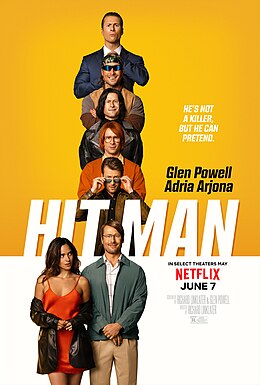
Here’s a screenplay pitch for you. Psychology professor by day, undercover cop by night. Not just an undercover cop, but an undercover cop posing as a hit man. In this least, I hope you say, “Go on.” On top of that basic premise, this psychology professor is the kind of forgettable, mild-mannered dweeb you fist imagined, but his hit man persona is a mix between Dirty Harry and John Wick. And as his college classes delve into questions about id and identity, he starts to wonder who he really is. When we get to the crisis moment, however, he’s no longer wondering if his true calling had always been undercover cop. He’s wondering if his true calling had been a real hit man.
That’s the premise of Richard Linklater’s Hit Man on Netflix. Seems like a surefire blockbuster. It’s even based on the true story of Gary Johnson, a psychology professor who had been moonlighting as an undercover cop for the Houston Police Department in the 80’s and 90’s. He’d been profiled by Skip Hollandsworth in Texas Monthly a few years ago. The problem, however, is that Linklater cleaved too closely the source material, creating a decent biopic rather than a blockbuster movie. I want to briefly delve into what didn’t work.

The big problem with this movie is that screenplays are complete fictions. While they may be based on real life, they are not real life. Real life is chaotic and absurd. Screenplays (hopefully) are not. Everything in a screenplay should be intentionally placed there to form a tight, cohesive narrative–a sort of logical argument. If A, then B; if B, then C; and so on until you end up with hopefully a logical and fulfilling conclusion.
I’ll defer to Anton Chekov here who rephrases what I’m trying to say much more directly and cleanly. “If in the first act you have hung a pistol on the wall, then in the following one it should be fired. Otherwise don’t put it there.” The screenplay for Hit Man, however, includes numerous unfired pistols. These come directly from Hollingsworth’s source material, and while they are fascinating glimpses into the human psyche, they do not progress the narrative or Gary Johnson’s growth as a character. (Keep in mind here that Gary Johnson the character is different than Gary Johnson the person.)
Here are three bizarre, true anecdotes from Hollingsworth’s article that Linklater chose to keep in the movie (despite their irrelevance to Johnson’s story). The first is an example of how a person starts looking for a hit man: a seedy gentleman asks a stripper(?!) if she could recommend anyone. Second, Hollandsworth writes about a teenager who wanted to off one of his classmates (changed to his mother in the movie). Third, he relates a family inheritance dispute that ends up with a brother forgiving his sister for trying to hire a hit man. The judge in the case grants her probation. All three of these anecdotes are crazy and fascinating, but I argue that you could cut them without losing anything. In fact, you’d have a better movie, and here’s why.
Go back to that first paragraph I wrote. If this movie is exploring whether or not Gary Johnson wants to become a real hit man, how exactly does the high school student fit in? Why is it important for the audience to go to the strip club and eavesdrop on two characters (the seedy patron and stripper) who we’ve never met and will never see again? In short, it’s not.
This is Gary Johnson’s story. Those scenes are deviations from that story. While they do show the diversity of clients that Johnson must deal with and his ability to read a variety of clients, we have another dozen characters in the “Undercover Gary Montage” that do the same thing. That makes those scenes unnecessary. Worse, it also makes them confusing.
At the point where we meet the teenager, this movie has established that Johnson is working with a variety of unsavory people and becoming increasingly comfortable in his role as a “hit man.” If we, the audience, see a deviation from norm that the screenplay has established for unsavory people (in this case because of age), the teenager becomes Chekov’s gun. We expect the story to pivot at this point. There is a complication to the movie’s “ordinary world.” The main protagonist must overcome this new obstacle and learn something about themselves. But…he doesn’t.
The other two scenes operate in a similar fashion. While they’re both interesting anecdotes (How does someone find a hit man? What happens after you learn that someone hired a hit man to kill you?) they aren’t central to the plot. They don’t tell us anything about Johnson’s new identity. Instead they introduce irrelevant characters and locations. They are “pistols” that never get fired. In the logical argument that is Gary Johnson’s story, they are Red Herrings.
It’s important to point out that Gary does have a meeting with a unique client that causes him to change his entire operation. Madison Masters is an attractive young woman trapped in an abusive relationship. Rather than going through with the sting, he suggests she get out of the relationship. He also begins to wonder if some people are, perhaps, legitimate targets for a hit man. That’s the crux of the movie. This is where things get interesting. This is in fact the inciting incident. Those other three anecdotes should have been left in the Hollingsworth’s profile piece.
Additionally, the movie suffers from an overused, uninteresting voiceover. And Gary Johnson’s character fails to adequately differentiate his “real” self and his hit man persona. What are we left with? An okay biopic that takes a handful of major liberties from the source material. As Hollandsworth’s original article proves, the truth is often stranger than fiction. Good fiction, however, is far more focused than reality.































 (Image via:











 Vargoing